Wayground logo

Free Printable Worksheets

Font size

S
M
L
XL
Worksheets

Environmental Review 6

Total questions: 23

Worksheet time: 44mins

Name
Class
Date
1.

An ____ is all the living and nonliving things that exist and interact in one place.

a)

producers

b)

ecosystem

c)

consumers

d)

population

2.

Nonliving (abiotic factors) include _____, _____ , ______ , and ___.

a)

soil, water, and air

b)

soil, water , air , and plants

c)

soil, water, air, and sunlight

d)

soil, water, air, and animals

3.

Living components can be sorted into three groups. What are the 3 groups?

a)

fish, water, and sharks

b)

producers, consumers, and decomposers

c)

living, nonliving, and home

d)

basic need, living, and nonliving

4.

__________ play the role of producers.

a)

animals

b)

sunlight

c)

plants

d)

energy

5.
Which gas in our atmosphere is most abundant?
a)
Argon
b)
Oxygen
c)
Nitrogen
d)
Carbon Dioxide
6.
Which front does this image represent ? 
a)
Cold front
b)
Stationary front
c)
Occluded Front 
d)
Warm front
7.
The boundary  between two air masses is known as:
a)
front
b)
storm
c)
climate
d)
flood
8.

What process occurs when tiny water droplets cling together in the atmosphere?

a)

clouds

b)

evaporation

c)

condensation

d)

accumulation

9.

What is the role of the sun in the water cycle?

a)

provide heat energy for evaporation

b)

provide heat energy for condensation

c)

dry out the soil for runoff to occur

d)

provide thermal energy for accumulation

10.

Which of the following is an example of precipitation?

a)

sleet

b)

hail

c)

snow

d)

all of the above

11.
What is the role of decomposers in an Ecosystem? 
a)
They recycle matter, carbon and nutrients to form fossil fuels
b)
They are burn and release as carbon dioxide
c)
Decomposers are responsible to turn oxygen into carbon dioxide
d)
They recycle energy back to the sun
12.
Producers are found at the _______ of the triangle
a)
bottom
b)
top
c)
middle
13.
What is a example of a abiotic factor?
a)
Panda
b)
Turtle
c)
Butterfly
d)
weather
14.
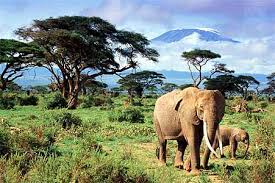
What are the biotic factors in this image?
a)
sunlight, elephants, and grasses
b)
sunlight, water,  and air
c)
elephants, plants, trees 
15.
When humans burn fossil fuels, most of the carbon quickly enters the                       as carbon dioxide.
a)
Water
b)
Atmosphere
c)
Sun
d)
Air
16.
Which one of these does not add CO2 to the atmosphere?
a)
cooking with gas
b)
planting trees
c)
burning wood
d)
riding in a bus
17.
Combustion is another word for _______________.
a)
a train
b)
a bus
c)
a dog
d)
burning
18.
This is the rapid, often poorly planned spread of development from an urban area outward into rural areas
a)
urban sprawl
b)
metropolitan area
c)
rural fringe
d)
whooping cough
19.
Which is a negative effect of urban sprawl?
a)
new, affordable homes
b)
more farmland
c)
destruction of habitats
d)
more people pass their geography quiz
20.
What is a metropolitan area?
a)
spreading of urban developments on a city
b)
A region that includes a central city and its surrounding suburbs
c)
The directness of routes linking pairs of places
21.

__________ is the contamination of water bodies, usually as a result of human activities.

a)

water poverty

b)

Famine

c)

water pollution

22.

____________ a long period when there is little or no rain.

a)

Dry season

b)

famine

c)

drought

d)

flood

23.

__________ changes in the world's weather, in particular the fact that it is believed to be getting warmer as a result of human activity increasing the level of carbon dioxide in the atmosphere:

a)

weather change

b)

climate change

c)

flood

d)

famine