
 Worksheets
MAGNETS AND MOMENTS
Total questions: 15
Worksheet time: 15mins

A seesaw is unbalanced with two people of different masses sitting equal distances from the center. Which of the following will result in equilibrium?
A The larger person moving further away from the center.
B Moving the smaller person closer to the center.
C Moving the smaller person further from the center.
D Making the larger person do nothing.
State the principle of moments
A When a system is in equilibrium, the sum of the total clockwise moment is equal to the sum of the total anti-clockwise moment about the same pivot.
B When a system is in equilibrium, the sum of the total clockwise moment is greater the sum of the total anti-clockwise moment about the same pivot.
C When a system is in equilibrium, the sum of the total clockwise moment is less than the sum of the total anti-clockwise moment about the same pivot.
D When a system is in equilibrium, the sum of the total clockwise moment is equal to the sum of the total anti-clockwise moment about the different pivot.
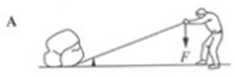
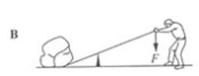
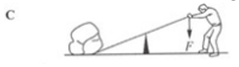
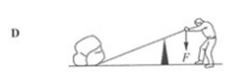
The figure below shows a man lifting a heavy rock using a steel bar. He pushes downwards on the end of the bar with a force F. Which pivot positions allows the force F to be as small as possible?
A student investigates which end of a magnetic compass needle is attracted to a bar magnet. What does the investigation show?
A Both ends of the compass needle are attracted by the north pole of the magnet.
B Both ends of the compass needle are attracted by the south pole of the magnet.
C One end of the compass needle is attracted by the north pole and the other end by the south pole.
D The compass needle is not attracted by either end of the magnet.
When iron touches a magnet, it becomes a magnet too.
A True
B False

If you put a magnet with two different poles together, they...
A repel (move away)
B attract (move closer)
The farther away the object is, the weaker the
A field
B magnet
C magnetic field
D poles

What is most likely to happen when the switch is closed?
A magnetic field should be produced
B The nail will rust
C The battery will explode
D The wire will catch on fire

A student wishes to use a magnetising coil to make a permanent magnet from a piece of metal. Which metal should she use?
A aluminium
B copper
C iron
D steel
A current that travels back and forth is an ___.
A direct current
B alternating current
In a magnet the ______________________ line up in the same direction.
A Domains
B nails
C wires

What happens to the strength of an electromagnet as you add more coils around it?
A Increases
B Decreases
C Stays the same
D Stops completely

A magnetic crane picks up pieces of metal in the picture. the crane magnet is made by electrified current and a coil. Most likely, what element is the metal?
A Copper
B steel
C aluminium
D iron
How many of the following materials conduct electricity?
aluminium silver iron plastic
A 1
B 2
C 3
D 4

Which line in the table shows whether iron and steel are ferrous or non-ferrous materials?
A
B
C
D

