
 Worksheets
Kinetics
Total questions: 20
Worksheet time: 43mins

The following data were measured for the reaction
BF3(g) + NH3(g) ⟶ F3BNH3(g)
What is the rate law for the reaction?
rate = k[NH3]
rate = k[BF3]2[NH3]
rate = k[BF3][NH3]
rate = k[BF3][NH3]2
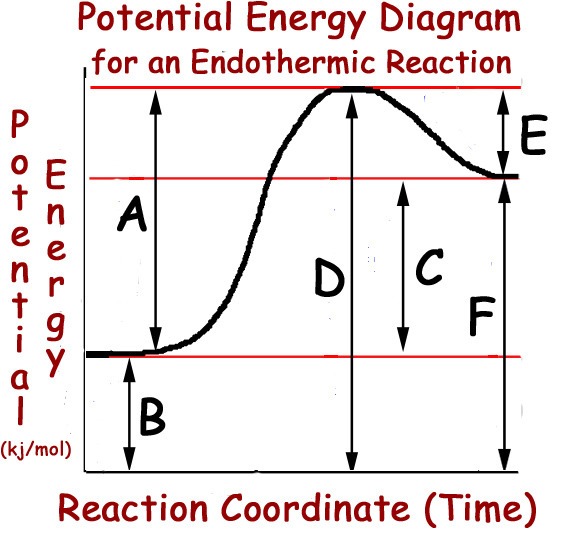
What letter represents the activation energy of the forward reaction?
A
B
C
D
Given the following rate law,
rate = k[A]2[B]
if [A] were doubled, what must happen to [B] to keep the rate constant?
[B] must quadruple
[B] must double
[B] must be havled
[B] must be quartered
A reaction is found to be second order with respect to carbon monoxide. If the concentration of carbon monoxide is doubled, the rate of reaction __________.
doubles
remains unchanged
increases by a factor of 4
is reduced by a factor of 2
Given the following balanced equation :
2NO(g) + Cl2(g) → 2NOCl(g)
If the rate of disappearance of Cl2 is 4.84 x 10⁻² Ms-1, what is the rate of disappearance of NO?
1.45 x 10⁻² Ms-1
2.42 x 10⁻² Ms-1
3.67 x 10⁻² Ms-1
9.68 x 10⁻² Ms-1
The catalyst alters the rate of a chemical reaction by,
providing an alternative pathway with a lower Ea
changing the products formed in the direction of the reaction
providing a surface on which the molecules react
increasing the frequencies of collisions between molecules
Reaction rate is a change in ______________ per unit time.
State
Volume
Concentration
Mass

The potential energy diagram below represents a reaction.
Which arrow represents the activation energy of the forward reaction
A
B
C
D

The beakers shown below, a 2.0 centimeter strip of magnesium ribbon reacts with 100 milliliters of HCl(aq) under the conditions shown
In which beaker will the reaction occur at the fastest rate?
A
B
C
D

The iodide ion reacts with hypochlorite ion in the following way:
OCl- + I- ⟶ OI- + Cl-.
This rapid reaction gives the rate data shown. What is the rate law?
rate = [OCl-]2[I-]
rate = [OCl-][I-]2
rate = [OCl-][I-]
rate = [OCl-]

Which species is the catalyst in this reaction mechanism?
R
W
X
There is no catalyst.

What is the rate law for this mechanism?
rate = k[A][B]2
rate = [B][X]
rate = [A]0.5[B]1.5
rate = [W][Y][Z]

What would the rate constant of the reaction be given the following set of experiments?


Using the following data, which is the correct rate law of the sample reaction?
A + 5B + 6C → 3D + 3E



