
 Worksheets
Plasma Membrane Transport
Total questions: 20
Worksheet time: 14mins
Plasma membrane .....
is selectively permeable
consist of triglyceride and cholesterol
separate cytoplasm and extracellular fluid
have proteins embedded the phospholipid bilayer

Name structure P
(a)

Choose correct statement(s) about structure R
makes membrane less fluid by restrain phospholipid movement
lower the temperature required for mombrane to solidify
is a type of lipid
can be found higher in plant compared to animals

Assuming the membrane is only permeable to water. What happens to slution level in SIDE B after 20 minutes?
increase
decrease
no change

Choose function of membrane protein shown in the figure.
Cell to cell recognition
Intercellular joining molecule
Enzymatic reaction
Involve in signal transduction

Figure shows three different plant cells immersed in solution with different concentration. Choose a normal healthy plant cell in the figure.
Cell A
Cell B
Cell C

Identify suitable stimulus to open ion gated channel in the figure.
Voltage
Mechanical
Chemical
Enzyme

How molecule in the figure can be transported across plasma membrane? (can be more than one answer)
Down concentration gradient
Using channel protein
Using carrier protein
Diffuse through phospholipid bilayer
How sucrose is transported into a plant cell?
Uses H+ gradient generated by proton ATP-powered proton pump.
Down its concentration gradient into the cell.
In the company of H+ that travels against its electrochemical gradient.
Uses sucrose transporter channel protein.
Statements below are true about receptor medited endocytosis EXCEPT .
It is a specialized type of pinocytosis.
It is a type of passive transport
Substance can be acquired even in low quantities in extracellular fluid
It enables cells to acquire bulk quantities of specific substance.
A major function of glycoproteins and glycolipids in the membane is to
glue cells together to form tissues
allow cells to identify each other
attach membrane to cytoskeleton
help retain shape

Which statements are true about active transport?
molecules move from low concentration to high concentration.
molecules move from high concentration to low concentration.
ATP is required
Uses channel proteins
Small polar molecules like O2 and CO2enter a cell through
simple diffusion
osmosis
facilitated diffusion
phagocytosis
Some celery sticks were placed in distilled water. What type of solution are they in? What will happen to the celery sticks?
hypotonic, the celery sticks increase in size
hypertonic, the celery sticks reduce in size
isotonic, the celery sticks remains in size

The animal cell on the left is in a(n) __________________ environment
Hypertonic
Hypotonic
Isotonic
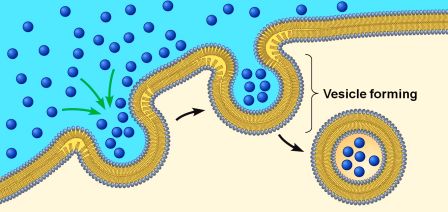
Which form of active transport is being shown?
Facilitated Diffusion
Exocytosis
Endocytosis
Proton pump
sodium-potassium pump transport
only potassium ions and sugar molecules
3 potassium ions out of the cell
3 sodium ions into the cell
2 potassium ions into the cell
white blood cells engulfing invading bacteria is an example of
Phagocytosis
Exocytosis
Pinocytosis
Facilitated Diffusion
Name small compartment enclosed by a membrane formed to transport of material during bulk transport.
vesicles
large vacuole
mitochondria
lysosome

