
 Worksheets
Graphing rational functions
Total questions: 29
Worksheet time: 2hrs 19mins
El dominio de una función racional son...
Todos los reales menos los valores que hacen el denominador negativo
Todos los reales menos los valores que hacen el denominador positivos
Todos los reales menos los valores que anulan el denominador
Todos los reales
La función f(x)=x−51 tiene una asíntota vertical en X= (a)
La función f(x)=x−51 tiene una asíntota horizontal en Y = (a)
La función f(x)=x−41 tiene asíntota vertical:
x=−4
y=−4
x=4
y=4

¿Cuál es la función que pertenece al grafico?
f(x)=x−12
f(x)=x2+1
f(x)=−x−12
Determina cuales de las siguientes funciones son racionales:
f(x)= 10x
f(x)= 9x−1015x2
f(x)= 17x2−14x+2x+2
f(x)= 21x2+10x−3
¿Cuál de los siguientes gráficos corresponde a una función racional?


f(x)=34x+2
La función f es una función:
Racional
Lineal
Cuadrática
trigonométrica
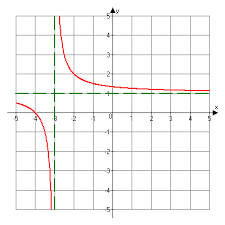
What are the asymptotes?
( la recta y=1 cuenta como asíntota)
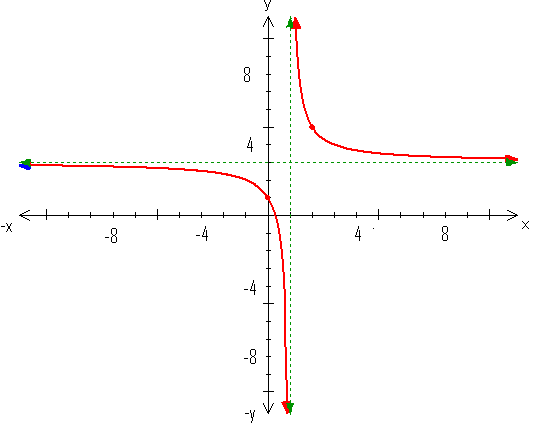
What are the asymptotes?( la recta horizontal verde cuenta como asíntota)
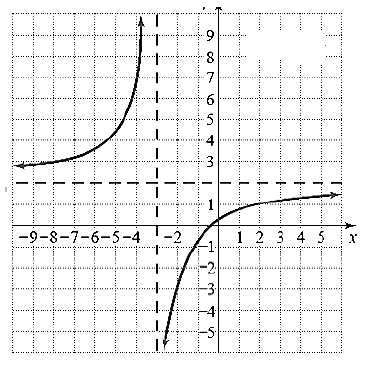
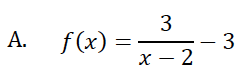
Which of the following represents the graph below?
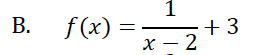
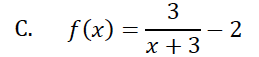
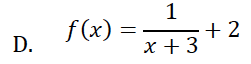

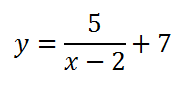
What is an asymptote?
an imaginary line that your function never touches
a part of your function
a point on your graph
a type of fruit

What is the domain and range?
D : (−∞,−3)∪(−3,∞)
R: (−∞,1)∪(1,∞)
D : (−∞,1)∪(1,∞)
R: (−∞,−3)∪(−3,∞)
D : (−∞,3)∪(3,∞)
R: undefined
D: (−∞,−1)∪(−1,∞)
R: (−∞,3)∪(3,∞)

What is the domain and range?
D: (−∞,1)∪(1,∞)
R: (−∞,2)∪(2,∞)
null
R: (−∞,21)∪(21,∞)
D: (−∞,−2)∪(−2,∞)
R: (−∞,−1)∪(−1,∞)

What is the horizontal asymptote?
x = 2
y = 2
x =-2
y=-2
R: All real number y≠ 1
R: All real number y≠ -3
R: All real number y≠ 1
R: All real number y≠ 3

Which graph represents the function?


Describe the transformations from the parent function, f(x) = 1/x.
Shift left 9 units, shift up 2 units
Shift right 9 units, shift up 2 units
Shift right 9 units, shift down 2 units
Shift right 2 units, shift down 9 units

Which is the graph of the rational equation:


Referring to f(x)= x1 how does f(x) = x+31 translate?.
Shifts right 3
Shifts up three
Shifts left three
Shifts down three
Referring to f(x)= x1 how does f(x) = x1+3 translate?
Shifts right 3 units.
Shifts up 3 units.
Shifts left 3 units.
Shifts down 3 units.
Referring to f(x) = x1 how does f(x) = x−41+1 Translate.
Shifts left 4 units and up 1 unit.
Shifts left 4 units and down 1 unit.
Shifts right 4 units and up 1 unit.
Shifts right 4 units and down 1 unit.
Referring to f(x) = x1 which function shifts down 6 units?
F(x) = x−61
F(x) = x1−6
F(x) = x+61
F(x) = x1+6

What is the equation of the rational function graphed?



