Wayground logo

Free Printable Worksheets

Font size

S
M
L
XL
Worksheets

Refraction and Lenses

Total questions: 20

Worksheet time: 29mins

Name
Class
Date
1.

the bending of light

a)

refraction

b)

reflection

c)

absorption

d)

transparent

2.
A _______ breaks white light into colors.
a)
prism
b)
visible spectrum
c)
shadow
d)
lens
3.
When all light can pass through an object, that object is:
a)
translucent
b)
transparent
c)
opaque
d)
reflected
4.
Light travels in ____ lines called waves.
a)
straight
b)
curvy
5.
A ___ lens makes objects appear bigger.
a)
concave
b)
convex
c)
prism
d)
flat
6.
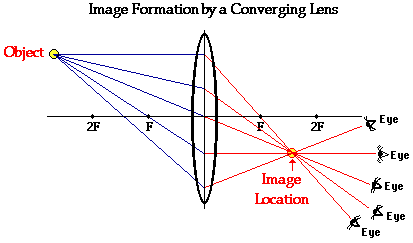
The point where the rays meet is known as....
a)
Fire
b)
the focal point
c)
refraction
d)
Plane of the lens
7.
This image is.....
a)
inverted and smaller
b)
inverted and larger
c)
not inverted and smaller
d)
not inverted and larger
8.
This image is...
a)
Inverted and smaller
b)
inverted and bigger
c)
not inverted and smaller
d)
not inverted and bigger
9.
This image is...
a)
Inverted and smaller
b)
Inverted and larger
c)
not inverted and smaller
d)
not inverted and larger
10.
An incident ray that is parallel to the principal axis...
a)
will reflect parallel to the principal axis
b)
will refract through the focal point
c)
will reflect through the center of curvature
d)
will continue along the same path through the lens
11.
a real image...
a)
is produced by virtual rays and can be projected on a screen
b)
is produced by real rays and cannot be projected on a screen
c)
is produced by virtual images and cannot be projected on a screen
d)
is produced by real rays and can be projected on a screen
12.
What is Nearsightedness? 
a)
condition that has difficulty seeing things that are close 
b)
condition that has difficulty seeing things that are far away
13.
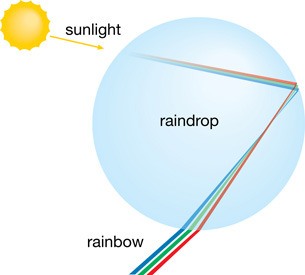
How is a rainbow created?
a)
All colors are reflected off of an object.
b)
White light is refracted through a prism.
c)
White light is reflected off of a mirror.
d)
All colors are absorbed by a prism.
14.
Rainbows are produced when
a)
light exits many raindrops at different angles
b)
the sun causes a rainstorm
c)
the spectrum causes a rainstorm
d)
the sun comes out after a storm
15.
Light bending as it passes through a rain drop is an example of...
a)
Refraction
b)
Reflection
16.

When will total internal reflection occur?

a)

When light travels from a less dense to a more dense medium

b)

When the angle of incidence is smaller than the critical angle

c)

When the angle of incidence is greater than the critical angle

d)

When the light cannot pass through a medium

17.

The above image is an example of a ____________. They happen because cool and hot air have a different ___________________________.

a)

Mirage; angle of incidence

b)

Optical fibre; refractive index

c)

Lateral inversion; angle of reflection

d)

Mirage; refractive index

18.

The focal length of this lens is _______.

a)

negative because it can form real images

b)

positive because it can form real images

c)

negative because it can form virtual images

d)

could be positive or negative depending on the image formed

19.

A person standing in front of a lens creates an image that is both smaller than the original and closer to the lens. Classify the image formed in this scenario.

a)

real, inverted

b)

real, upright

c)

virtual, inverted

d)

virtual, upright

20.

Classify the image formed in this scenario.

a)

real, inverted, larger than original

b)

real, inverted, smaller than original

c)

virtual, upright, larger than original

d)

virtual, upright, smaller than original