wayground logo

Free Printable Worksheets

NEW

Font size

S
M
L
XL
Worksheets

Science Form 2_Chap 9.3 Principle of Expansion & Contraction

Total questions: 15

Worksheet time: 7mins
Name
Class
Date
1.
What are the three states of matter?
a)
solid, volume, mass
b)
density, volume, mass
c)
solid, liquid, gas
d)
density, gas, volume
2.
Adding HEAT to matter causes its particles to:
a)
move faster and farther apart
b)
Move slower and farther apart
c)
Move faster and closer together
d)
Move slower and closer together
3.

When temperature increases (gets "hotter"), the volume of matter increases (gets bigger).

a)

Dissolving

b)

Compression

c)

Thermal Expansion

d)

Diffusion

4.

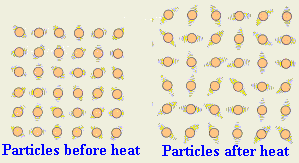
This picture is an example of...

a)

Compression

b)

Diffusion

c)

Thermal Expansion

d)

Dissolving

5.
When the temperature of matter decreases the particles ...
a)
speed up and move farther apart
b)
speed up and move closer together
c)
slow down and move farther apart
d)
slow down and move closer together
6.
When air in a hot air balloon is heated the air inside the baloon...
a)
expands
b)
contracts
c)
evaporates
d)
condenses
7.
Railroad tracks have gaps between rails so they don't buckle in hot weather because
a)
thermal conductivity
b)
specific heat
c)
thermal expansion
d)
thermal insulation
8.

When thermal energy is added to a substance, the substance's particles move:

a)

More rapidly at an increased distance from each other.

b)

More rapidly with less distance between each other.

c)

More slowly with a greater distance between each other.

d)

More slowly with a reduced distance between each other.

9.
Thermal energy always moves:
a)
From a high temperature object to a lower temperature object.
b)
From a lower temperature object to a higher temperature object.
c)
From an object with lower kinetic energy to an object with higher kinetic energy.
d)
From an object of higher mass to an object of lower mass.
10.
If an object has particles that are moving very slowly, the object's temperature is probably ______.
a)
hot
b)
small
c)
cold
d)
big
11.
If an object has particles that are moving very quickly, the object 's temperature is probably _____.
a)
cold
b)
slow
c)
big
d)
hot
12.

If the movement of the atoms increases, you can assume the temperature was _________.

a)

Increased

b)

Decreased

c)

Not Changes

13.

Which is NOT a part of the particle kinetic theory of matter?

a)

All atoms are in motion

b)

The faster atoms move, the more energy they have.

c)

All matter is made of atoms

d)

The atoms in a solid are not moving.

14.
When objects absorb heat, the particles...
a)
gain energy and vibrate at fixed position.
b)
gain energy and increase in size.
c)
gain energy and move slower.
d)
gain energy and move faster.
15.
When objects contract upon cooling...
a)
volume increases and density increases.
b)
volume increases and density decreases.
c)
volume decreases and density decreases.
d)
volume decreases and density increases.