wayground logo

Free Printable Worksheets

NEW

Font size

S
M
L
XL
Worksheets

G7 Science Review

Total questions: 61

Worksheet time: 1hrs 7mins

Name
Class
Date
1.
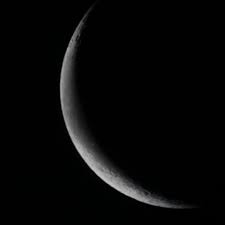
What Moon phase is this?
a)
Full Moon
b)
Waxing Gibbous
c)
New Moon
d)
Half Moon
2.
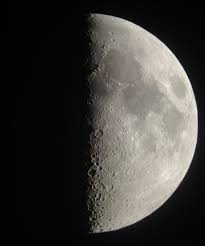
What Moon phase is this?
a)
Waxing Crescent
b)
Waning Gibbous
c)
Waning Crescent
d)
Waxing Gibbous
3.
Name the moon phase
a)
waning crescent
b)
waxing crescent
c)
waning gibbous
d)
waxing gibbous
4.
Name the moon phase
a)
First Quarter
b)
Last Quarter
c)
New Moon
d)
Full Moon
5.

Neap tides happen at _________ and _________ phases of the moon.

a)

first quarter and new moon

b)

last quarter and full moon

c)

waxing and waning

d)

1st quarter and 3rd quarter

6.

What type of tide is evident when the moon is in the full moon phase?

a)

high tide

b)

low tide

c)

spring tide

d)

neap tide

7.

In what positions would the Earth experience a spring tide?

a)

A

b)

B

c)

C

d)

A and C

8.

In what positions would the Earth experience a neap tide?

a)

B

b)

C

c)

D

d)

B and D

9.
Which season is taking place in the Northern Hemisphere in Position 1?
a)
Winter
b)
Spring
c)
Summer
d)
Fall
10.
Which season is taking place in the Northern Hemisphere in Position 2?
a)
Winter
b)
Spring
c)
Summer
d)
Fall
11.
Which season is taking place in the Northern Hemisphere in Position 3?
a)
Winter
b)
Spring
c)
Summer
d)
Fall
12.
Which season is taking place in the Northern Hemisphere in Position 4?
a)
Winter
b)
Spring
c)
Summer
d)
Fall
13.

This model is showing us a...

a)

lunar eclipse

b)

solar eclipse

c)

phases of the moon

d)

earth eclipse

14.

This image is showing us a.....

a)

solar eclipse

b)

lunar eclipse

c)

phases of the moon

d)

earth eclipse

15.
This is a diagram of the moon phases. In which phase would a solar eclipse occur?
a)
New Moon
b)
1st quarter
c)
Full Moon
d)
3rd Quarter
16.

Which of the following is a renewable resource?

a)

Oil

b)

Solar

c)

Coal

d)

Natural Gas

17.

Which of the following is a non-renewable resource?

a)

Water

b)

Sun

c)

Coal

d)

Win

18.

Hyrdo Power is a __________ energy resource.

a)

Renewable

b)

Non-renewable

19.

Oil is a __________ energy resource.

a)

Renewable

b)

Non-renewable

20.

Combination of two or more different kinds of substances that keep their own physical properties and can be easily separated.

a)

Solution

b)

Mixture

c)

Solubility

d)

Miscibility

21.

This is a type of mixture where one substance dissolves into another

a)

Solution

b)

Miscibility

c)

Compound

d)

Solubility

22.
Which list has the types of mixtures ordered from largest particle size to smallest?
a)
suspension, colloid, and solution
b)
solution, suspension, and colloid
c)
colloid, solution, and suspension
d)
solution, colloid, and suspension
23.

Which two characteristics do all forces have?

a)

motion and size

b)

size and direction

c)

direction and speed

d)

balance and direction

24.
What is the net force? 
a)
25N Up ON Left
b)
50N Left 25N Down 
c)
175N Up 50N Down 
d)
100N Right 75N Up
25.

What is the net force (calculation).

a)

5 N Right

b)

19 N Left

c)

13 N Right

d)

13 N Left

26.
You walk 10 meters to math class in 20 seconds. Your average speed is
a)
2 m/s
b)
0.5 m/s
c)
200 m/s
d)
5 m/s
27.
A runner races in the 100 meter dash.  It takes her 10 seconds to finish.  What is her average speed?
a)
10 m/s
b)
1000 m/s
c)
100 seconds
d)
10 seconds
28.
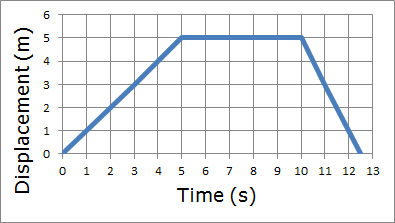
According to the graph how far does the person travel in the first 5 seconds?
a)
2 m
b)
10 m
c)
0 m
d)
5 m
29.

A 40-kg person is climbing 3 m up a flight of stairs in 6 seconds. How much work did they do climbing the stairs?

a)

400 J

b)

1200 J

c)

200 J

d)

120 J

30.

A 40-kg person is climbing 3 m up a flight of stairs in 6 seconds. How much power did they exert climbing the stairs?

a)

400 W

b)

1200 W

c)

200 W

d)

120 W

31.
What is the metric unit of Force?
a)
Meters
b)
Joules
c)
Newtons
d)
Watts
32.
What is the metric unit of Power?
a)
Newtons
b)
Watts
c)
Meters
d)
Joules
33.
Which is doing work?
a)
pushing a wall
b)
holding a box
c)
picking up a pencil
d)
sitting in a chair
34.
A force exerted over a distance to move an object is ______________________.
a)
power
b)
work
c)
momentum
d)
Watt
35.

If 150 Joules of work is needed to move a box 10 meters, what force was used?

a)

1500 N

b)

15 N

c)

1.5 N

d)

150 N

36.
What is the equation for work?
a)
W = mass * acceleration
b)
W = force * distance
c)
W = force/distance
d)
W = speed/time
37.
What is the equation for power?
a)
P = Work/time
b)
P = Force/time
c)
P = time/distance
d)
P = Work * time
38.
What is the unit of measurement for Power?
a)
Joules
b)
Newtons
c)
Watts
d)
Meters
39.
Consumer that eats plants
a)
heterotroph
b)
herbivore
c)
producer
d)
community
40.
Which of the following is NOT a consumer
a)
grass
b)
dog
c)
shark
d)
fish
41.
What percentage of energy is passed on to each tropic level?
a)
10%
b)
50%
c)
90%
d)
100%
42.

Several food chains linked together make up

a)

food web

b)

food pyraid

c)

ecosystem

43.
An organism that gets energy from breaking down dead organisms, non-living material or waste is a(an) ___________.
a)
producer
b)
consumer
c)
decomposer
d)
autotroph
44.
An animal that gets energy from eating both plants and animals is a(an) _____________.
a)
herbivore
b)
carnivore
c)
omnivore
d)
autotroph
45.
Which is an example of a behavioral adaptation?
a)
claws
b)
beak
c)
thumb
d)
migration
46.
An example of a physical adaptation is...
a)
a turtle hiding inside its shell
b)
The spikes on a porcupine fish
c)
a rabbit burrowing underground
d)
a viper biting when threatened
47.
The praying mantis looks very much like a blade of grass. What is it called when animals look like other animals or plants?
a)
camouflage
b)
mimicry
c)
locomotion
d)
hibernation
48.

A chameleon lies next to a large blue flower so predators can NOT find it. This is an example of

a)

camouflage

b)

mimicry

c)

migration

49.

The scientific name for an organism is made from the:

a)

class and family name

b)

genus and species name

c)

domain and kingdom name

d)

kingdom and phylum name

50.

An example of an unicellular organism would be:

a)

monkey

b)

bacteria

c)

spider

d)

human

51.
I am prokaryotic and am found everywhere. What kingdom do I belong to?
a)
Eubacteria
b)
Archaebacteria
c)
Fungi
d)
Protista
52.

What is the correct order of taxonomy?

a)

Kingdom, pylum, class, species, genus, family, class

b)

Species, genus, family, order, class, phylum, kingdom

c)

Kingdom, phylum, class, order, family, genus, species

d)

species, phylum, order, class, kingdom, family, genus

53.
Cells that do not have a true nucleus are called....
a)
eukaryote
b)
prokaryote
c)
unicellular
d)
multicellular
54.
Cells that have a true nucleus are called....
a)
eukaryotes
b)
prokaryotes
c)
unicellular
d)
multicellular
55.
Organisms in this smallest taxonomic group share many characteristics.
a)
domain
b)
kingdom
c)
species
d)
class
56.
Survival of the Fittest and Evolution were proposed by what scientist?
a)
Charles Darwin
b)
Albert Einstein
c)
Steven Hawking
d)
Isaac Newton
57.
Where the better adapted organisms survive to pass traits along to offspring.
a)
Evolution
b)
Natural Selection
c)
Extinction
d)
Artifical Selection
58.

What word describes a trait that helps an organism survive in its environment?

a)

natural selection

b)

mutation

c)

camouflage

d)

adaptation

59.
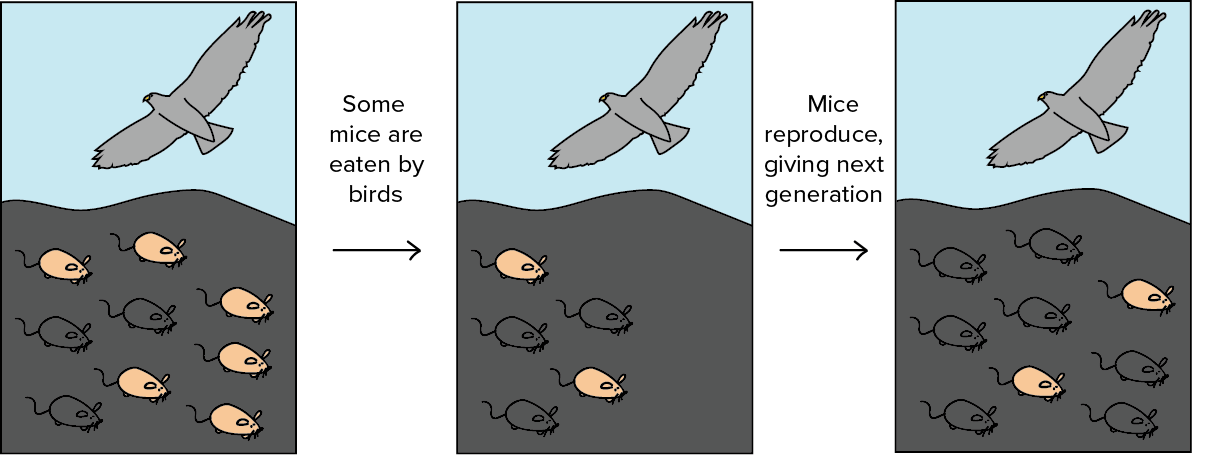
Why is the mouse population changing over time?
a)
The light mice can reproduce more successfully than the dark mice
b)
The hawks eat more dark mice than light mice because the dark mice taste better
c)
The hawks eat more light mice than dark mice because they can see the light mice more easily
d)
The hawks eat more dark mice than light mice because they can see the dark mice more easily
60.
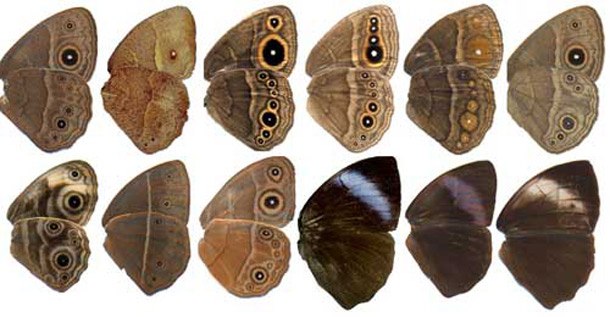
These moths are all the same species. The differences between their wings is an example of ________________
a)
Natural Selection
b)
Variation
c)
Homeostasis
d)
Extinction
61.
Why are advantageous traits more likely to be passed on to the offspring?
a)
Because parents with those traits can teach their offspring
b)
Because parents with those traits can surive and reproduce better
c)
Because parents with those traits care more about their offspring