wayground logo

Free Printable Worksheets

Font size

S
M
L
XL
Worksheets

light

Total questions: 58

Worksheet time: 3hrs 54mins

Name
Class
Date
1.

the bending of light

a)

refraction

b)

reflection

c)

absorption

d)

transparent

2.
A _______ breaks white light into colors.
a)
prism
b)
visible spectrum
c)
shadow
d)
lens
3.
When light cannot pass through an object, that object is:
a)
transparent
b)
translucent
c)
opaque
d)
a prism
4.
White light is made up of:
a)
red, yellow, and blue
b)
no colors
c)
all colors
d)
red, green, and blue
5.
A ___ lens makes objects appear bigger.
a)
concave
b)
convex
c)
prism
d)
flat
6.
A __ lens makes objects appear smaller and further away.
a)
convex
b)
concave
c)
prism
d)
flat
7.
Why does green grass look green?
a)
It reflects all colors except green.
b)
It absorbs all colors except green.
c)
It only absorbs green.
d)
The colors mix to make green.
8.
How is a rainbow created?
a)
All colors are reflected off of an object.
b)
White light is refracted through a prism.
c)
White light is reflected off of a mirror.
d)
All colors are absorbed by a prism.
9.

In this photograph, the water droplet is acting like a lens. Lenses work because of _________.

a)

reflection

b)

refraction

c)

diffraction

d)

interference

10.

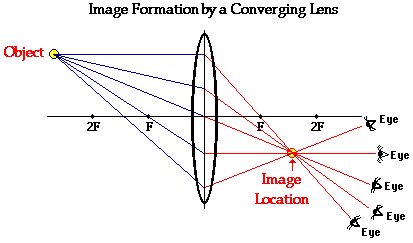
The lens pictured is exhibiting _______ behavior and is ______ in shape.

a)

converging, convex

b)

converging, concave

c)

diverging, convex

d)

diverging, concave

11.

Which of the following correctly labels points A, B, and C?

a)

focal point, focal length, principal axis

b)

focal point, principal axis, focal length

c)

principal axis, focal length, focal point

d)

focal length, focal point, principal axis

12.

The focal length of this lens is _______.

a)

negative because it can form real images

b)

positive because it can form real images

c)

negative because it can form virtual images

d)

could be positive or negative depending on the image formed

13.

The lens pictured is exhibiting _______ behavior and is ______ in shape.

a)

converging, convex

b)

converging, concave

c)

diverging, convex

d)

diverging, concave

14.

Classify the image formed in the droplet. Check two.

a)

real

b)

virtual

c)

inverted

d)

upright

15.

Classify the image produced by the projector lens. Check two.

a)

real

b)

virtual

c)

larger than original

d)

smaller than original

16.

Classify the image in the viewfinder lens of the camera.

a)

real

b)

virtual

c)

inverted

d)

upright

17.

Classify the image formed in the magnifying glass.

a)

real

b)

virtual

c)

larger than original

d)

smaller than original

18.

The focal length in this scenario is

a)

-1.5 units

b)

1.5 units

c)

2.5 units

d)

4.0 units

19.

Classify the image formed in this scenario.

a)

real, inverted, larger than original

b)

real, inverted, smaller than original

c)

virtual, upright, larger than original

d)

virtual, upright, smaller than original

20.

A person standing in front of a lens creates an image that is both smaller than the original and closer to the lens. Classify the image formed in this scenario.

a)

real, inverted

b)

real, upright

c)

virtual, inverted

d)

virtual, upright

21.
What does the word "converging" mean?
a)
to separate
b)
to come together
c)
parallel 
d)
perpendicular
22.
A converging lens is also known as a ____ lens.
a)
convex
b)
concave
c)
double
d)
refracted
23.
When an object is placed on the focal point in front of a convex lens, the image produced is ___.
a)
real, reduced, and inverted
b)
real, enlarged, and inverted
c)
real, true, and inverted
d)
There is no image
24.
When an object is placed between the focal point and the convex lens, the image produced is ___.
a)
real, reduced, and inverted
b)
real, enlarged, and inverted
c)
virtual, enlarged, and upright
d)
virtual, reduced, and upright
25.
A diverging lens is also known as a ____lens.
a)
refracted
b)
diffracted
c)
convex
d)
concave
26.
The point where the rays meet is known as....
a)
Fire
b)
the focal point
c)
refraction
d)
Plane of the lens
27.
This image is.....
a)
inverted and smaller
b)
inverted and larger
c)
not inverted and smaller
d)
not inverted and larger
28.
This image is...
a)
Inverted and smaller
b)
inverted and bigger
c)
not inverted and smaller
d)
not inverted and bigger
29.
Is a convex lens thicker or thinner in the middle?
a)
Thicker 
b)
Thinner 
30.
What type of lens do humans have in their eyes? 
a)
Concave Lens 
b)
Convex Lens 
31.
A converging lens is also known as a ____ lens.
a)
convex
b)
concave
c)
double
d)
refracted
32.
What does the word "diverging" mean?
a)
to spread apart
b)
to come together
c)
parallel
d)
perpendicular
33.
Images produced by a diverging lens are always _____.
a)
real, reduced, and inverted
b)
virtual, reduced, and upright
c)
real, enlarged, and inverted
d)
virtual, enlarged, and upright
34.
In the formula m = hi/ho, if the variable "hi" is negative, that implies that the image is ___.
a)
true
b)
upright
c)
inverted
d)
reduced
35.
If the focal point is a negative number, the lens is _____.
a)
convex
b)
concave
c)
virtual
d)
real
36.
___ is when light travels through a material and bends.
a)
Diffraction
b)
Dispersion
c)
Mirage
d)
Refraction
37.
An image that you can see , but does not really exist is called which of the following?
a)
Real Image
b)
Fake Image
c)
Virtual Image
d)
Digital Image
38.
Which type of lens is shown?
a)
Concave
b)
Convex
c)
Reflective
d)
Refracting
39.
What kind of lens is shown?
a)
Concave
b)
Convex
Convex
c)
Specular
Concord
d)
Diffuse
Plane
40.
_____ is a lens that is thicker in the middle and makes an object appear bigger.
a)
prism
b)
convex lens
c)
concave lens
d)
mirror
41.
The dfor a real image will be a _________________ value
a)
positive
b)
negative
42.
A converging lens produces an image twice the size of the original. If the object is placed 0.40 m from the lens, and the image produced is 0.80 m from the lens. What is the focal length of the lens? 
a)
0.351 m
b)
0.267 m
c)
0.416 m
d)
0.112 m
43.

A tree 20 m high is located 40 m from the converging lens of focal length 0.08 m.Calculate the distance from the lens to the image.

a)

0.08 m

b)

0.01 m

c)

0.10 m

d)

0.20 m

44.
The dfor a virtual image will have a ______ value.
a)
positive
b)
negative
45.

An object is located 35.0 cm from a convex lens. The lens forms a real image at a distance of 15.0 cm. What is the focal length?

a)

0.0953 cm

b)

10.5 cm

c)

26.2 cm

d)

0.0678 cm

46.

What type of image is formed?

a)

virtual and inverted

b)

virtual and upright

c)

real and upright

d)

real and inverted

47.
In the thin lens equation, do represents 
a)
Distance of the object from the lens
b)
Distance of the image from the lens
48.
A normal human eye has a focal length of about 0.023 m. If you look at the tip of a pencil, 0.553 m from your eye, how far is the image from the lens of your eye? 
a)
0.024 m
b)
0.033 m
c)
0.045
d)
0.055
49.
The focal length of the lens in your eye is about 0.015 m. If the object is 1 m from your eye, where is the image produced? 
a)
0.0315 m
b)
0.0243 m
c)
0.0152 m
d)
0.0601 m
50.

Images in a plane mirror are

a)

real

b)

larger

c)

same size

d)

smaller

51.

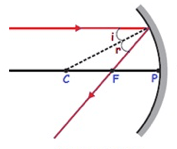
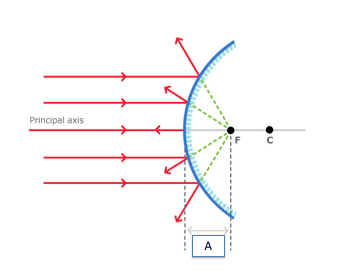
This ray diagram is for which mirror?

a)

concave

b)

convex

c)

plane

d)

window

52.

In the image, all the rays meet at F, What is F

a)

focal length

b)

focal point

c)

center of curvature

d)

reflection

53.

The angle of incidence is equal to the angle of reflection

a)

Law of Reflection

b)

Law of Light

c)

Incidence Ray

d)

The Normal

54.

A shopkeeper wants to keep an eye on his store in order to prevent shoplifting. What could the shopkeeper hang on the wall in order to see a wider image of his store and his customers?

a)

a convex mirror

b)

a concave mirror

c)

a convex lens

d)

a concave lens

55.

A dentist uses a small dental mirror to help magnify teeth in your mouth. What type of mirror is this?

a)

a convex mirror

b)

a concave mirror

c)

a convex lens

d)

a concave lens

56.

The side view mirrors on your car help shrink the image on both sides of the car, allowing you to see a larger field of view. What type of mirror is this?

a)

a convex mirror

b)

a concave mirror

c)

a convex lens

d)

a concave lens

57.
Convex Mirrors produce...
a)
only virtual images
b)
virtual or real images
c)
only real images
d)
inverted images
58.
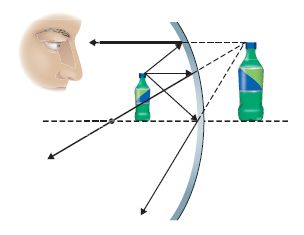
Which terms describe the reflection seen in this image?
a)
virtual, upright
b)
virtual, inverted
c)
real, upright
d)
real, inverted