
 Worksheets
Rivers and Flooding
Total questions: 33
Worksheet time: 28mins
Whats the beginning of a river called?
Start
Source
Mouth
Sauce
Which of the following is not a method of transportation?
Traction
Saltation
Suspension
Corrosion
Infiltration is....
Transfer of water
Water passing into the soil
Water flowing on the earth's surface
Water moving through the soil
In what part of the river are you most likely to find a Levee?
Lower
Upper
Middle
What is the end of a river called?
The end
Finish
Mouth
Nose
In what part of a river are you likely to find a v-shaped valley?
Upper
Middle
Lower
Name the transportation process: small particles are carried by floating in the water.
Saltation
Suspension
Traction
Abrasion
What is the longest river in the UK?
Trent
Severn
Thames
Meon
Where are you most likely to find a waterfall?
Lower course
Source
Meander
Upper course
What is attrition?
When you manually move rocks
When two eroded particles hit each other
When an eroded particle scrapes across the river bed
When a rock rolls along the river bed
What transportation process is only common in high energy river channels?
Traction
Suspension
Abrasion
Hydraulic action

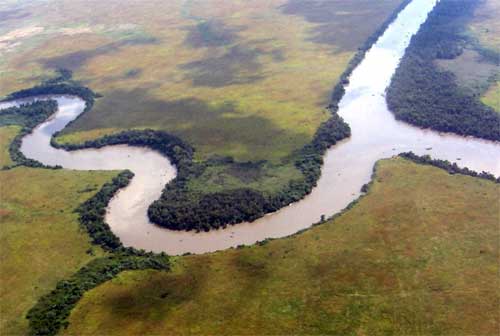
Name the feature
Meander
Ox bow lake
Lake
Levee
The water flows fastest on the ___________ bend of each meander
Outside
Inside
Define alluvium
a deposit of silt and sand left by flowing floodwater
Particles of rock deposited in the upper course
Soil eroded by the energy of the river

Name the river feature
Interlocking hills
Meander
Tributary
Interlocking spurs
Which of the following is not a type of river erosion?
Percolation
Abrasion
Attrition
Hydraulic Action
When the force of the water being carried by the river wears away the bed and banks
Hydraulic action
Percolation
Throughflow
Hydraulic solution
What is condensation?
A change of state in which gas becomes a liquid
A change of state in which a liquid becomes a gas
Water falling from the air as hail, rain or snow
The hydrological cycle is also known as
The carbon cycle
The water cycle
The nutrient cycle
The nitrogen cycle
The watershed is:
A building made to house water
A shed which is built on stilts above a river
The ridge of land separating two or more drainage basins
The flat surface area around the river channel that periodically floods is called the
floodplain.
stream.
river basin.
Which of the following photos shows dredging river channel?


Raised area that helps prevent flooding; may be natural or artificial
flood plain
hill
levee
divide

Saltation
Particles bounce along the river bed or sea floor
Pebbles roll along the river bed or sea floor
Particles suspended within the water
Dissolving of chemicals
Restricting different land uses to certain locations on the floodplain - areas close to the river are kept clear of high-value land uses.
River restoration
Floodplain zoning
Flood warnings
Flood relief channels
The volume of water moving by a particular location in a river per unit time is the rivers
discharge.
runoff.
drainage equation.
What is the name for the part of the hydrograph where the waters are going up?
Rising limb
Surging limb
Advancing limb
Growing limb

What is the missing label on this diagram?
leg time
lag time
leg length
lag length
Drainage basins with high levels of ______ are MOST likely to flood.
Surface runoff
Throughflow
Groundwater flow

