
 Worksheets
DNA structure and replication
Total questions: 20
Worksheet time: 28mins
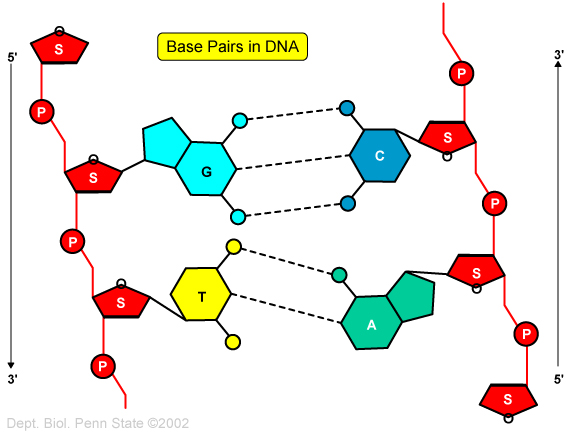
Which 2 molecules form the sides (backbone) of the DNA ladder?
deoxyribose sugar and purine
deoxyribose sugar and a hydrogen bond
deoxyribose sugar and pyrimidine
deoxyribose sugar and phosphate
3' A A A T T T C 5'
The matching strand would read...

Which enzyme is responsible for adding the RNA primer to the template strand?
Helicase
DNA Polymerase
Ligase
Primase
ATG TGA CAG
Which enzyme joints the Okazaki fragments in the lagging strand?
Helicase
Polymerase
Ligase
Primerase

What did Meselson and Stahl conclude?
DNA is conservative. Radioactive strand forms nonradioactive strand. The nonradioactive strands bind to themselves and the radioactive strands bind to themselves
DNA is semiconservative. You see two bands in the R2 stage. Middle band is half radioactive, half nonradiaoctive.
DNA is dispersive. Some radioactiveness spreads to the other strands. Thus, in R2, you would only have one density middle band.
DNA undergo conservative replication for the first generation, but follow semiconservative replication in the following generations.


What is the correct order for DNA replication?
Unwinding, Initiation, Termination
Unwinding, Initiation, Elongation, Termination
Unwinding, elongation, initiation, termination
Initiation, unwinding, elongation, termination

What is the difference between DNA polymerase III and DNA polymerase I?
DNA P1 replaces the RNA primer with DNA nucleotides, leaving ligase to bind the phosophodiester bonds
DNA P1 recognizes the RNA primer, extends the chain, and proofreads sequences
DNA P3 replaces the RNa primer with DNA nucleotides, leaving ligase to bind the phosphodiester bonds
DNA P3 works together with DNA P2
Function of helicase is
Unwind DNA double strand
Relieve strain of DNA strand
Add free DNA nucleotide
Forming lagging strand

RNA differs from DNA in all of the following except:
RNA is a single strand instead of a double strand.
Uracil replaces Thymine as a nitrogenous base.
Ribose sugar is used instead of deoxyribose.
RNA is antiparallel to DNA.

The point at which two strands of a DNA molecule split is called:
Origin of replication
Replicated nucleotides
Antiparallel strands
Replication fork

What are antiparallel DNA strands?
DNA strands that run opposite to each other
DNA strands that run in the same direction
DNA strands that contain the same nucleotides
DNA strands that need repaired

