wayground logo

Free Printable Worksheets

NEW

Font size

S
M
L
XL
Worksheets

Flower anatomy & pollination

Total questions: 51

Worksheet time: 29mins
Name
Class
Date
1.
What is the male part of the flower called?
a)
pistil
b)
petal
c)
stamen
d)
leaf
2.
What is the female part of the flower called?
a)
pistil
b)
stamen
c)
leaf
d)
petal
3.
What is pollen?
a)
a thick substance
b)
a watery substance
c)
a fine powdery substance
4.
Which of the following is a pollinator?
a)
spider
b)
terminator
c)
bee
d)
ant
5.
Which of the following is NOT a pollinator?
a)
bees
b)
humming bird
c)
fruit bat
d)
scorpion
6.
A plant can have both male and female parts.
a)
True
b)
False
7.
Bees' original motive to go from flower to flower are to get to what?
a)
stamen
b)
nectar
c)
pollen
8.
Why do bees need nectar?
a)
to eat
b)
to sleep
c)
for honey
d)
to be sticky
9.
Pollination can occur between flowers of the same plant. 
a)
True 
b)
False 
10.
Pollination can occur between flowers of the different plants of the same species. 
a)
True 
b)
False 
11.
I have large petals and are usually brightly coloured. How am I pollinated?
a)
By animals
b)
By birds 
c)
By insects 
d)
All of the above
12.
I am a flower that produces nectar. What is the function of the nectar?
a)
To provide food for the flower
b)
To attract pollinators
c)
To attract animals to disperse the fruits
d)
To produce perfumes for Man
13.
Pollination is the process by which the pollen grains are transferred from the ________ to the _________. 
a)
anther... ovary
b)
anther ... stigma
c)
stigma ... ovary 
d)
stigma ... filament
14.
Which of the following is/are types of pollination?
A) wind pollination 
B) Insect pollination 
C) explosive pollination  
a)
B only
b)
A and B only
c)
All of the above
15.
Wind-pollinated flowers usually have ______ and ________ petals. 
a)
big ... bright 
b)
small .... bright 
c)
big ... dull 
d)
small ... dull
16.
My flowers are not sweet-scented and I do not produce nectar. How am I likely dispersed by?
a)
By wind 
b)
By insects 
c)
By water 
d)
By explosive action
17.
I have long and feathery stigma that sticks out of the flower. How am I likely to be pollinated by?
a)
By wind 
b)
By insects 
c)
By water 
d)
By explosive action
18.
My pollens are usually sticky and spiky so that they can _______________. 
a)
stay on the pollinators' body without falling off easily 
b)
prevent pollinators from eating them
19.
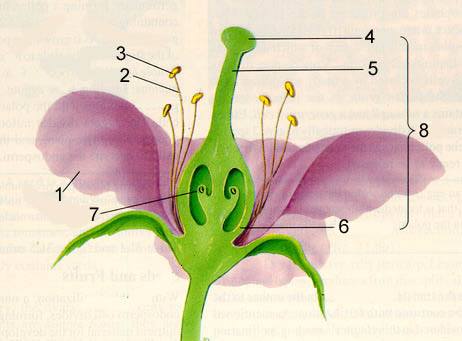
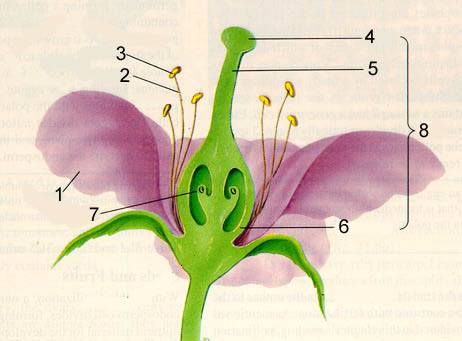
What is #2 pointing to?
a)
anther
b)
filament
c)
ovary
d)
style
20.
What is #4 pointing to?
a)
anther
b)
style
c)
stigma
d)
ovary
21.

Which part of the flower is brightly coloured and attracts insects?

a)

anther

b)

stigma

c)

petal

d)

filament

22.
Where is pollen made?
a)
ovary
b)
petal
c)
pistil
d)
anther
23.
What is the sticky part of the flower that catches pollen?
a)
style
b)
stigma
c)
ovary
d)
petal
24.

Which word could describe the stigma in a wind pollinated flower?

a)

feathery

b)

sticky

c)

smooth

d)

light

25.

What is inside of the Ovary?

a)

Stem

b)

Oval

c)

Ovule(s)

d)

Petal

26.

The male gamete of a plant.

a)

pollen

b)

egg

27.
The part of the flower on which the pollen grains land.
a)
pistil
b)
stamen
c)
sepals
d)
stigma
28.

Which process happens first...

a)

Pollination and then fertilisation

b)

Fertilisation and then pollination

29.

Where does the pollen have to land before a pollen tube can form?

a)

stigma

b)

style

c)

anther

d)

ovary

30.

Where are the female gametes found?

a)

In the anther

b)

In the stigma

c)

In the ovules

31.

What is fertilisation?

a)

The process of transferring the pollen from one flower to another

b)

The fusion of the male and female gamete

c)

The growth of an embryo

32.
What is #5 pointing to?
a)
anther
b)
filament
c)
stigma
d)
style
33.
What is #6 pointing to?
a)
stigma
b)
style
c)
ovary
d)
petal
34.
What part of the flower will turn into a fruit?
a)
petal
b)
ovary
c)
ovule
d)
stamen
35.
The filament___________
a)
holds up the anther
b)
protects the petal
c)
is the male part of the flower
d)
catches pollen
36.
The style____________
a)
connects the stigma to the ovary
b)
holds up the anther
c)
smells great
d)
produces pollen grains
37.
Which part attracts insects and mammals to the flower
a)
sepal
b)
petal
c)
ovaries
d)
style
38.
The sepal_________
a)
smells good
b)
protects and supports the flower
c)
attracts other animals
d)
produces pollen grains
39.
The yellow, powdery stuff on the stamens
a)
Pollen
b)
Dust
c)
Mites
d)
Germs
40.
Pollination is the process by which pollen
a)
causes people to sneeze
b)
is formed inside a plant
c)
moves from stamen to pistil
41.
I have long and feathery stigma that sticks out of the flower. How am I likely to be pollinated by?
a)
By wind 
b)
By insects 
c)
By water 
d)
By explosive action
42.

How can bees survive during winter?

a)

by eating nectar

b)

by eating honey

c)

by eating pollen

d)

by eating flowers

43.

Which honeybee is male and fertilized the eggs?

a)

queen

b)

wasp

c)

drone

d)

worker

44.

Which is the most common type of bee?

a)

worker

b)

queen

c)

drone

d)

fuzzy

45.

True or False. A worker bee will die after they sting.

a)

True

b)

False

46.

Why is a worker bee only able to sting once?

a)

They need to collect more pollen

b)

Their organs get ripped out and they die

c)

They get kicked out of the hive

d)

They take over as queen

47.

Which type of honeybee lays eggs?

a)

queen

b)

drone

c)

worker

48.

Where do worker bees collect pollen and nectar?

a)

the hive

b)

plants and flowers

c)

water

d)

honey

49.

Which type of bee is kicked out of the hive after they are no longer needed?

a)

drone

b)

worker

c)

queen

50.

Which type of bee mainly cares for the hive?

a)

queen

b)

worker

c)

drone

51.

Which bee is NOT female?

a)

worker

b)

drone

c)

queen