
 Worksheets
Uniform Circular Motion
Total questions: 20
Worksheet time: 11mins
Name
Class
Date
1.
What force keeps an object moving in a circle?
a)
centripetal force (inward)
b)
centrifugal force (outward)
2.
The velocity is always _____ to the line of a circle.
a)
outwards
b)
towards the center
c)
tangent
d)
faster
3.
What type of acceleration does an object moving with constant speed in a circular path experience?
A) free fall
B) constant acceleration
C) linear acceleration
D) centripetal acceleration
A) free fall
B) constant acceleration
C) linear acceleration
D) centripetal acceleration
a)
A
b)
B
c)
C
d)
D
4.
An object moves in a circular path at a constant speed. Compare the direction of the object's velocity and acceleration vectors.
A) Both vectors point in the same direction.
B) The vectors point in opposite directions.
C) The vectors are perpendicular.
D) The question is meaningless, since the acceleration is zero
A) Both vectors point in the same direction.
B) The vectors point in opposite directions.
C) The vectors are perpendicular.
D) The question is meaningless, since the acceleration is zero
a)
A
b)
B
c)
C
d)
D
5.
Is it possible for an object moving with a constant speed to accelerate? Explain.
A) No, if the speed is constant then the acceleration is equal to zero. B) No, an object can accelerate only if there is a net force acting on it.
C) Yes, although the speed is constant, the direction of the velocity can be changing.
D) Yes, if an object is moving it can experience acceleration
A) No, if the speed is constant then the acceleration is equal to zero. B) No, an object can accelerate only if there is a net force acting on it.
C) Yes, although the speed is constant, the direction of the velocity can be changing.
D) Yes, if an object is moving it can experience acceleration
a)
A
b)
B
c)
C
d)
D
6.
An object moves with a constant speed of 30 m/s on a circular track of radius 150 m. What is the magnitude of the acceleration of the object?
A) zero
B) 0.17 m/s2
C) 5.0 m/s2
D) 6.0 m/s2
A) zero
B) 0.17 m/s2
C) 5.0 m/s2
D) 6.0 m/s2
a)
A
b)
B
c)
C
d)
D
7.
Two masses m and M are separated by a distance d. If the distance between the masses is increased to 3d, how does the gravitational force between them change?
a)
becomes 1/3 as great
b)
1/9 as great
c)
3x greater
d)
9x greater
8.
When an object experiences uniform circular motion, the direction of the acceleration is
A) in the same direction as the velocity vector.
B) in the opposite direction of the velocity vector.
C) is directed toward the center of the circular path. D) is directed away from the center of the circular path.
A) in the same direction as the velocity vector.
B) in the opposite direction of the velocity vector.
C) is directed toward the center of the circular path. D) is directed away from the center of the circular path.
a)
A
b)
B
c)
C
d)
D
9.
A 0.50-kg mass is attached to the end of a 1.0-m string. The system is whirled in a horizontal circular path. If the maximum tension that the string can withstand is 350 N. What is the maximum speed of the mass if the string is not to break?
A) 700 m/s
B) 26 m/s
C) 19 m/s
D) 13 m/s
A) 700 m/s
B) 26 m/s
C) 19 m/s
D) 13 m/s
a)
A
b)
B
c)
C
d)
D
10.
Which one of the following statements concerning the two “gravitational constants” G, the universal constant, and g the magnitude of the acceleration due to the gravity is true?
a)
The value for G and g do not depend on location.
b)
The value of G is the same everywhere in the universe, but the value of g is not.
c)
The value of G and g are equal on the surface of any planet, but in general, vary with location in the universe.
11.
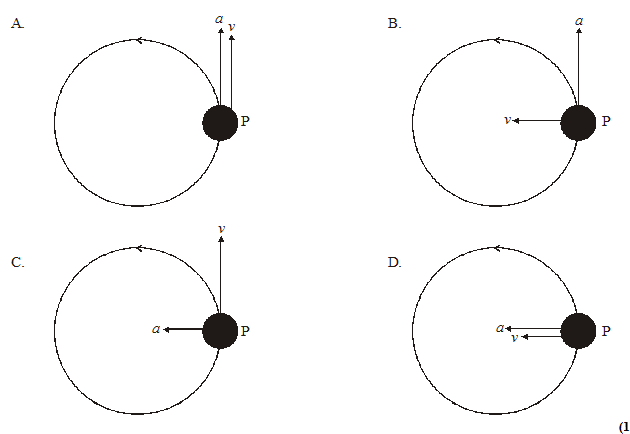
A particle P is moving in a circle with uniform speed. Which one of the following diagrams correctly shows the direction of the acceleration a and velocity v of the particle at one instant of time?
a)
A
b)
B
c)
C
d)
D
12.
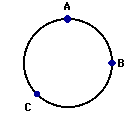
What is the direction of the velocity at point B, if the ball is revolving clockwise?
a)
up
b)
right
c)
down
d)
left
13.

What is the direction of the velocity at point A, if the ball is revolving clockwise?
a)
up
b)
right
c)
down
d)
left
14.

Which represents the acceleration of the ball?
a)
A
b)
B
c)
C
d)
D
15.
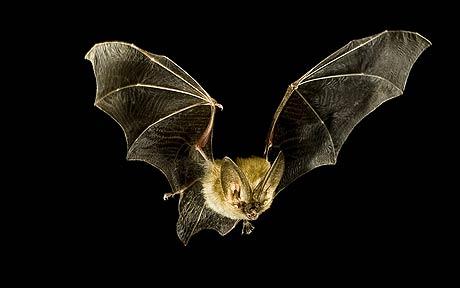
Bruno the bat has a mass of 0.58 kg and flies at a speed of 0.8 m/s in circle of radius 0.5 m. What is his acceleration?
a)
0.25 m/s2
b)
1.3 m/s2
c)
1.6 m/s2
d)
0.74 m/s2
16.
Which statement is true about an object that is traveling in uniform circular motion?
a)
The speed of the object varies.
b)
The net force on the object is directed toward the center of the circular path.
c)
The direction of the object's velocity is constant.
d)
The net force on the object is directed away from the center of the circular path.
17.
A race car completes three laps of a circular track with a radius of 35 m in 9.0 seconds. Determine the speed of the car.
a)
3.9 m/s
b)
73.3 m/s
c)
24.4 m/s
d)
1.0 m/s
18.

Why do objects experience centripetal acceleration?
a)
Because they are speeding up as they move in a circle
b)
Because they are constantly changing direction and the net change is directed inward
c)
Because they are constantly changing both speed and direction
d)
Because when you have 100 people pedaling, you can speed up more easily.
19.
What happens if you let go of the string when you spin the stopper around your head?
a)
the stopper continues moving in a circle
b)
the stopper moves in a straight line
20.
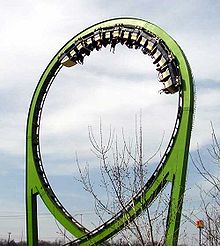
Where is the net force when the rollercoaster is at the top of the loop?
a)
Towards the sky
b)
Towards the Right
c)
Towards the left
d)
Towards the ground
100 %

