
NEW
Font size
 Worksheets
Diffraction of Waves
Total questions: 15
Worksheet time: 8mins

This image depicts which of the following wave behaviors?
Reflection
Refraction
Diffraction
Resonance
Definition: The spreading out of waves as they pass through an opening or around objects.
Reflection
Refraction
Diffraction
Resonance
Light waves and sound waves are similar in that...
They are both longitudinal waves
They are both transverse waves
They both transmit energy
They both can travel through space.
A wave of constant wavelength diffracts as it passes through an opening in a barrier. As the size of the opening is increased, the diffraction effects
decrease
increase
remain the same

The diagram shows a series of wave fronts approaching an opening in a barrier. Point P is located on the opposite side of the barrier. The wave fronts reach point P as a result of
resonance
refraction
reflection
diffraction
Which wave phenomenon makes it possible for a player to hear sound from a referee's whistle in an open field even when standing behind the referee?
diffraction
Doppler effect
reflection
refraction
A wave is diffracted as it passes through an opening in a barrier. The amount of diffraction that the wave undergoes depends on both the
amplitude and frequency of the incident wave
wavelength and speed of the incident wave
wavelength of the incident wave and the size of the opening
amplitude of the incident wave and the size of the opening
Which diagram best represents the shape and direction of a series of wave fronts after they have passed through a small opening in a barrier?
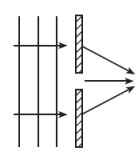
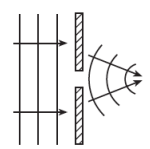
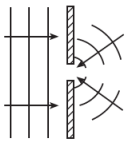
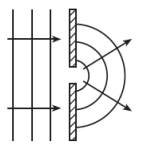
Parallel wave fronts incident on an opening in a barrier are diffracted. For which combination of wavelength and size of opening will diffraction effects be greatest?
short wavelength and narrow opening
short wavelength and wide opening
long wavelength and narrow opening
long wavelength and wide opening
Radio waves diffract around buildings more than light waves do because, compared to light waves, radio waves
move faster
move slower
have a higher frequency
have a longer wavelength
Waves pass through a 10-centimeter opening in a barrier without being diffracted. This observation provides evidence that the wavelength of the waves i
much shorter than 10 cm
equal to 10 cm
longer than 10 cm but shorter than 20 cm
longer than 20 cm
The spreading of a wave into the region behind an obstruction is called
diffraction
absorption
reflection
refraction

This diagram shows a series of straight wave fronts produced in a shallow tank of water approaching a small opening in a barrier.



