
 Worksheets
Kepler's law
Total questions: 22
Worksheet time: 11mins
What this means is that if a satellite moves away from what it is orbiting,

Which planet will take the most amount of time to revolve around the Sun?
Mercury
Venus
Earth
Mars
The orbital radius of Venus is 10.8×10¹⁰ m . Its rotation period is 224.7 days. What is its orbital speed.
20 km s−1
25 km s−1
35 km s−1
62 km s−1

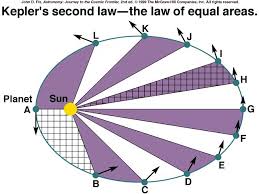
Diagram shows a planet orbiting around the sun. Based on Kepler's Second Law, Which of the following regarding the speeds of the planet at positions
vp =vQ =vR
vp >vQ >vR
vp <vQ <vR
vp >vR >vQ

Which of the following shows correctly the relationship between the period of orbit, T and radius of orbit, r, of a planet?
A
B
C
D

Diagram shows the planet Saturn with its four satellites. R and T are orbital radius and orbital period of satellites respectively.
Which of the following statements is true?
the orbital periods of all the satellites are the same.
The force on the satellite is tangential to the orbit
the attractive force on each satellite is directly proportional to R21
R2T3 is constant for all satellites.
What is the reason for the motion of the moon on its orbit?
The gravitational force exerted on the Earth by the moon
The gravitational force exerted by the sun
The gravitational force exerted by the planets
The gravitational force exerted on the Moon by the earth
A kine drawn from a planet to the Sun always sweeps over equal areas in equal intervals of time When the planet moves further from the sun, the planet will move
Faster
Slower
Constant at every point
None of the above
The period of geostationary artificial satellite is
24 hours
6 hours
48 hours
12 hours
The period of a satellite in a circular orbit of radius R is T. The period of another satellite in circular orbit of radius 4R is
8T
8T
2T
4T
The distance of venus and Saturn from the sun are nearly 1011 m and 1012 m respectively. Assuming that they move in circular orbits, their periodic times would be in ratio of
0.10.1
100
1010
10000
Kepler’s third law states
The orbit of a planet around the sun is an ellipse, with the sun at one focus
The semimajor axis is equal to the planet’s average distance from the sun
The square of the orbital period of a planet is proportional to its orbital radius
None of these answers is correct
If r represents the radius of the orbit of a satellite of mass m moving round a planet of mass M the velocity of the satellite is given by
V=(rGM) ,
v2 = rGMm
v=r2GMm
v2 = RgM
Kepler's third law is represented by the following equation:
Hukum Kepler ketiga ditunjukkan oleh persamaan:


The period of the Moon's orbit is 27.0 days. The radius of the Moon's orbit is 3.8 ×10⁸ m. The period of a geostationary satellite is 1 day. What is the radius of the geostationary satellite's orbit.
4.2 ×10⁷ m
5.4 ×10⁷ m
6.6 ×10⁷ m
8.5 ×10⁷ m
The accelerations due to gravity on the surfaces of two planets are equal in magnitudes if
mass
radiusmass
radius2mass
radius3mass
Class
4R
4T
4P
NAME

