

wayground logo

Free Printable Worksheets

Font size

S
M
L
XL
Worksheets

1.3 - Common Feedback Systems

Total questions: 16

Worksheet time: 48mins
Name
Class
Date
1.
Maintaining body temperature is an example of a:
a)
negative feedback loop
b)
positive feedback loop
2.
Humans have ___ for body temperature, blood glucose concentrations, electrolyte concentrations, pH levels, tendon tension and variables.
a)
positive feedback mechanisms
b)
set points
c)
a wide internal range
d)
no regulation
3.
If the environment gets cold, we will often shiver in order to:
a)
keep body temperature the same as the external temperature
b)
decrease body temperature
c)
increase body temperature
d)
regulate blood pressure
4.
When glucose levels in the blood rise, your brain sends a signal to your pancreas. The pancreas releases insulin, which opens channels in cell membranes to allow glucose to enter the cell, lowering blood sugar levels. 
a)
Positive Feedback Response
b)
Negative Feedback Loop 
5.
As you get dehydrated, your blood becomes thicker and harder to pump. Your kidneys will respond by stopping urine production, sending the water from urine into your bloodstream to thin your blood back to normal level.
a)
Positive Feedback Response
b)
Negative Feedback Loop 
6.
Rapid growth during puberty causes your body to release more and more growth hormones. As you grow, more and more growth hormones are released until puberty is reached, and then the hormones stop.
a)
Positive Feedback Response
b)
Negative Feedback Loop 
7.
If the calcium in your blood decreases below homeostasis levels, a gland in the brain will sense the decrease and send a chemical message to your bones. Your bones will release calcium into the blood, bringing blood calcium levels back up.
a)
Positive Feedback Response
b)
Negative Feedback Loop 
8.
Feedback loops are important because they allow organisms and the environment to
a)
change based on new inputs
b)
fall apart
c)
change based on new outputs
d)
maintain balance
9.
When you get cut, your skin cells release hormones that signal platelets to come and stop the bleeding. Platelets then release more hormones that signal even more platelets to help stop bleeding. The hormone signals continue until the cut is closed.
a)
Positive Feedback Response
b)
Negative Feedback Loop 
10.
The name for a chemical made by glands that tell cells to make something or respond in some way.
a)
acid
b)
enzyme
c)
perspiration
d)
hormone
11.
Humans have ___ for body temperature, blood glucose concentrations, electrolyte concentrations, pH levels, tendon tension and variables.
a)
positive feedback mechanisms
b)
set points
c)
a wide internal range
d)
no regulation
12.

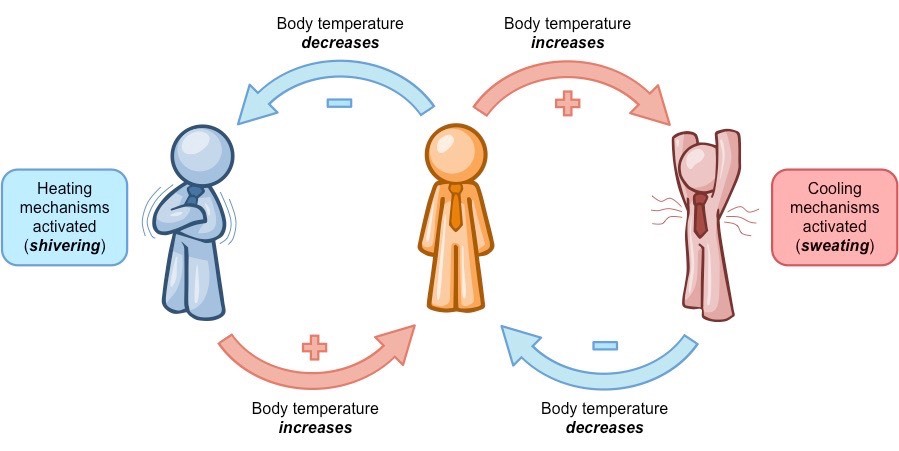
In this body temperature feedback loop, predict what would happen if cooling mechanisms were NOT activated?

a)

The body would not warm up.

b)

The body would not cool down.

c)

Your body would get colder and colder.

d)

Your body would release lots of heat.

13.

According to the feedback loop, what does high blood sugar promote?

a)

Insulin Release

b)

Glucagon Release

c)

Insulin Uptake

d)

Glycogen Uptake

14.

What happens if stretch receptors are activated in the uterus?

a)

Oxytocin will cause uterine muscles to relax

b)

Contractions will get weaker

c)

The baby will be born later than normal

d)

The brain will signal for the release of oxytocin

15.

If the anterior pituitary does not release TSH, what will happen?

a)

Thyroid follicles will not release T3 and T4

b)

The hypothalamus will release TRH

16.

What is the difference between what will happen if their is too much Glucose or too little Glucose? SELECT ALL THAT APPLY

a)

With too much Glucose, Insulin is released. With too little Glucose, Glucagon is released.

b)

With too much Glucose, the pancreas produces insulin. With too little Glucose, the pancreas produces glucagon.

c)

With too much Glucose, Glucagon is released. With too little Glucose, Insulin is released.

d)

There is no difference.
