
Font size
 Worksheets
Chapter 2 : Kinematics of linear motion
Total questions: 16
Worksheet time: 17mins

What is the formula to calculate speed?
v = time / displacement
v = displacement / time
v = displacement x time
v = time x displacement

Velocity is vector quantity. It has both ____ and _____.
magnitude , direction
direction, mass
volume, density
velocity , magnitude


What value will you get if you calculate the gradient of a v-t graph
acceleration
velocity
deceleration
displacement

Describe this graph
object move to left
constant acceleration
increasing displacement
zero acceleration

Describe this graph
constant acceleration
constant deceleration
object move to the left
constant velocity

What is the similar graph with above graph?


Describe this graph
constant acceleration
constant deceleration
object move to the left
constant velocity

At 60 seconds, how far had this object traveled?
30 m
10 m
60 m
40 m

What happened during C to D point?
not moving
increasing speed at a constant rate
moving at a constant speed
moving at zero acceleration
All of the following may cause an object to accelerate EXCEPT
change in direction of velocity
change in magnitude of velocity
change in time taken
change in both magnitude and direction of velocity
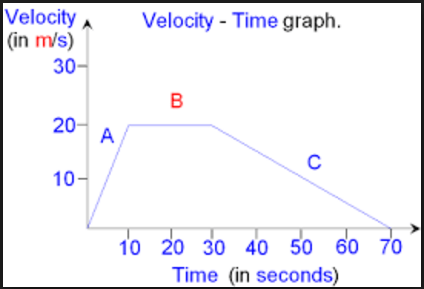
This is a velocity-time graph. What is the object doing in segment A?
Positive acceleration
Negative acceleration
Constant Velocity
Not moving

