wayground logo

Free Printable Worksheets

NEW

Font size

S
M
L
XL
Worksheets

Population ecology

Total questions: 21

Worksheet time: 14mins

Name
Class
Date
1.
What factor describes when populations increase because animals are moving into a population?
a)
Emigration
b)
Limiting Factors
c)
Immigration
d)
Exponential Growth
2.
What factor describes when populations decrease because animals are moving out of a population?
a)
Emigration
b)
Limiting Factors
c)
Immigration
d)
Exponential Growth
3.

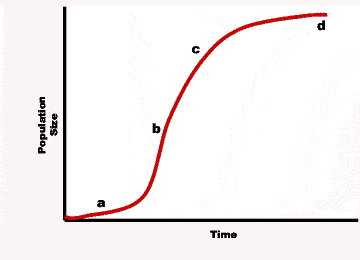
This population is growing exponentially. A population can only continue to grow exponentially when

a)

predators are exterminated.

b)

all resources are available without any limits.

c)

there is a shortage of habitats

d)

niches are already filled.

4.

This population is in logistic growth. In logistic growth, a population that was growing rapidly stops growth and maintains/stabilizes its population size because

a)

the population has hit the ecosystem's carrying capacity.

b)

the number of prey suddenly increased.

c)

immigration increased.

d)

birth rate increased.

5.
What does the graph represent?
a)
Emigration
b)
Exponential growth
c)
Immigration
d)
Logistic Growth
6.
What does the graph represent?
a)
Emigration
b)
Exponential growth
c)
Immigration
d)
Logistic Growth
7.
True or False: Limiting factors can be population dependent and population independent.
a)
True/Cierto
b)
False/Falso
8.
Which limiting factor would increase due to the number of individuals in a population?
a)
Unusual weather
b)
Natural disaster
c)
Births
d)
Disease
9.

Which limiting factor is independent of the number of individuals in a population?

a)

competition

b)

parasitism/disease

c)

stress

d)

natural disasters

10.
Which of the following is TRUE of predator/prey relationships?
a)
The amount of prey does not affect the number of predators.
b)
Herbivores are limited by the number of prey in an ecosystem.
c)
Humans are not considered predators.
d)
The number of predators is determined by available prey.
11.
Which of the following will increase the size of a population?
a)
emigration and births
b)
immigration and deaths
c)
immigration and births
d)
emigration and deaths
12.
Which of the following statements about primary succession is true?
a)
It begins with a climax community
b)
Small mammals are the first to live there
c)
It begins with bare rock
d)
It begins with rock and soil
13.
Diseases may spread more rapidly when an area is crowded, so disease is considered to be a
a)
type I survivorship curve
b)
population crasher
c)
density-dependent limiting factor
d)
population enhancer
14.
A sequence of biotic changes that regenerate or create an ecological community is known as
a)
factors
b)
erosion
c)
succession
d)
progression
15.
Lichens and mosses that first live in uninhabited areas are examples of
a)
secondary species
b)
non-native species
c)
pioneer species
d)
climax species
16.
Secondary succession is most likely to occur
a)
on a volcanic island
b)
after a rainstorm
c)
after a Thanksgiving Turkey dinner
d)
after a forest fire
17.

What point on the graph represents carrying capacity?

a)

a

b)

b

c)

c

d)

d

18.

At carrying capacity, a population __________.

a)

increases rapidly

b)

increases slowly

c)

decreases slowly

d)

stops growing and reach stability with its ecosystem able to support it.
19.
When a population has reached carrying capacity
a)
Growth & Immigration are equal to Death & emigration
b)
Growth & Immigration are less than Death & emigration
c)
Growth & Immigration are greater than Death & emigration
d)
Growth is exponential
20.
One reason predators might increase is
a)
The weather is warmer
b)
Parasites have increased
c)
The prey have increased
d)
Food has decreased
21.
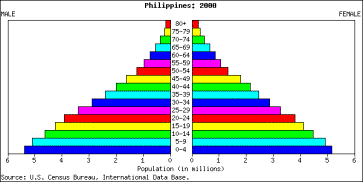
According to the population pyramid of this country, its population is most likely...
a)
growing slowly.
b)
growing rapidly.
c)
decreasing.
d)
not changing.