wayground logo

Free Printable Worksheets

Font size

S
M
L
XL
Worksheets

refraction

Total questions: 25

Worksheet time: 22mins

Name
Class
Date
1.
The velocity of light in vacuum is _______ m/s
a)
3x10⁸
b)
3x10¹²
c)
3x10⁶
d)
3x10¹⁰
2.
How does light behave as it enters these mediums?
a)
continue its path as straight line.
b)
bends toward the normal
c)
bends away from the normal
d)
reflects
3.
Absolute refractive index of any medium is always _______.
a)
less than 1
b)
greater than 1
c)
1
d)
0
4.
Swimming pools and the ocean look shallower than they really are due to:
a)
reflection 
b)
dispersion
c)
refraction
d)
total internal reflection
5.
The formula to calculate the refractive index is
a)
n=cv
b)
n=v/c
c)
n=c/v
d)
v=nc
6.
Glass has a _____________ index of refraction than air.
a)
Equal
b)
Greater
c)
Less
d)
Impossible to say
7.
Light has the lowest velocity in which medium?
flint glass n=1.70
barium glass n=1.60
crown glass n=1.523
water n=1.33
diamond n=2.45
a)
diamond
b)
water
c)
flint glass
d)
barium glass
8.
The point where the rays meet is known as....
a)
Fire
b)
the focal point
c)
refraction
d)
Plane of the lens
9.
What is this image showing?
a)
Reflection
b)
Refraction
c)
The law of reflection
d)
Concave Mirror
10.
Why does the lower part of the child appear so much different in size from the upper part?
a)
The light rays that travel through water and then into air are refracted.
b)
The light rays that travel through water and then into air are enlarged.
c)
The light rays that travel through air and then into water are reflected.
d)
The light rays that travel through air and then into water are reduced.
11.

Light travels through air, water, glass and many other materials. What path does it travel to get from one place to another?

a)

sideways

b)

back and forth

c)

straight

d)

up and down

12.

When light goes from one material(medium) to another it becomes bent, what term means bent?

a)

reflected

b)

refracted

c)

absorbed

d)

turned

13.

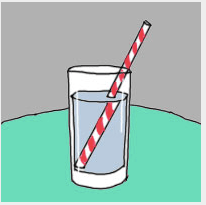
Why does the straw appear to be bent?

a)

light is reflected

b)

light is absorbed

c)

light is turned

d)

light is refracted

14.

When light passes from air to water, what happens to the speed of the light?

a)

speeds up

b)

slows down

c)

stays the same

15.

What do we call a material that light can travel through?

a)

air

b)

water

c)

medium

d)

pathway

16.

What type of lens is wider in the middle than on the edges?

a)

Concave

b)

Convex

c)

Objective

d)

Ocular

17.

What type of lens is thinner in the middle than at the edges?

a)

Convex

b)

Concave

c)

Objective

d)

Magnifying

18.

When light passes through a convex lens, it does this.....

a)

Diverge, or spread apart

b)

Converge, or come together

c)

Reflect, or bounce off

d)

Create a rainbow

19.

The point at which light rays converge after passing through a convex lens is called what.

a)

The Horizon Point

b)

The Point Break

c)

The Focal Point

d)

The Perspective

20.

When light waves move from passing through air to passing through a glass lens when happens to them?

a)

They slow down and change direction

b)

They speed up and change direction

c)

They maintain the same speed and change direction

d)

They maintain their same speed and direction

21.

The angle of the incoming rays of light are also called the.....

a)

Angle of reflection

b)

Angle of refraction

c)

Angle of incidence

d)

Wave angle

22.
The formula to calculate the refractive index is
a)
n=cv
b)
n=v/c
c)
n=c/v
d)
v=nc
23.
When light passes at an angle to the normal from one material into another material in which its speed is lower
a)
it is bent towards the normal.
b)
it always lies along the normal.
c)
it is unaffected.
d)
it is bent away from the normal.
24.

What is the speed of light in water of refractive index 1.33?

a)

3.0×10⁸m/s

b)

2.0×10⁸m/s

c)

2.3×10⁸m/s

d)

3.9×10⁸m/s

25.

Which of the following is a correct representation of snell's law?

a)

n1sinθ2=n2sinθ1

b)

n1sinθ1=n2sinθ2

c)

n2sinθ1=n1sinθ2

d)

n1/sinθ1=n2/sinθ2