
 Worksheets
CHEMICAL KINETICS
Total questions: 18
Worksheet time: 13mins

The following data were measured for the reaction
BF3(g) + NH3(g) ⟶ F3BNH3(g)
What is the rate law for the reaction?
rate = k[NH3]
rate = k[BF3]2[NH3]
rate = k[BF3][NH3]
rate = k[BF3][NH3]2
Given the following rate law,
rate = k[A]2[B]
if [A] were doubled, what must happen to [B] to keep the rate constant?
[B] must quadruple
[B] must double
[B] must be havled
[B] must be quartered
rate = k[A]
The rate constant in the rate law above is 0.5 L/mol·s. If the initial concentration of A is 0.1 M, how long will it take for [A] to drop to 0.025 M?
0.7 s
1.4 s
2.8 s
There is not enough information given.

What is the rate law for this mechanism?
rate = k[A][B]2
rate = [B][X]2
rate = [A]0.5[B]1.5
rate = [W][Y][Z]
Which factors increase the rate of a reaction?
increasing temperature
increasing concentration
increasing surface area
all of the above
Which of the following best describes why increasing temperature increase reaction rate?
Activation energy is reduced.
Collisions become more frequent.
Collisions become more energetic.
Collisions become more frequent and more energetic.
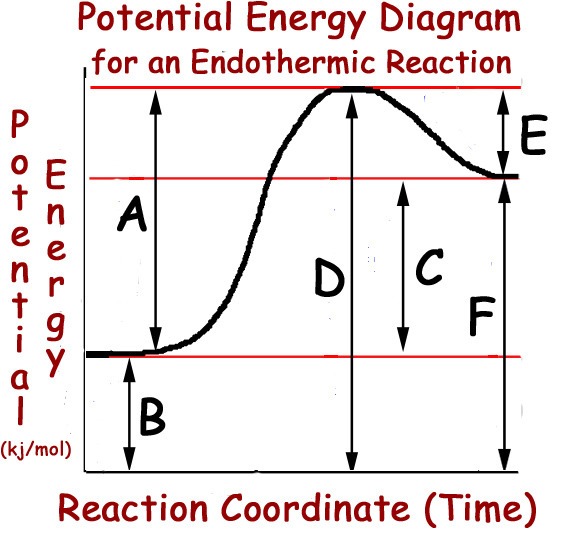
What letter represents the activation energy?
A
B
C
D
What is the parameter to measure the rate or speed of a reaction beside time?
Change in volume
Change in concentration
Change in pressure
Change in temperature

Which species is the catalyst in this reaction mechanism?
R
W
X
There is no catalyst.
Rate=[A]2[B]1


