
 Worksheets
Latent Heat
Total questions: 25
Worksheet time: 1hrs 17mins
There are four main processes in changing of phase, and they are
Melting
Boiling
Condensation
All the above
Latent heat is
the heat absorbed or released at a boiling process during a change of phase
the heat absorbed or released at a constant temperature during a change of phase
the heat absorbed or released at a constant temperature during a change of phase of 1 kg object
the heat absorbed or released by an object to increase or decrease its temperature by 1 degree Celcius
The heat absorbed by melting a solid is known as
latent heat of fusion
latent heat of solid
latent heat of liquid
latent heat of vaporisation
specific latent heat of vaporisation is
the amount of heat required to change 1 kg of the substance from the solid to liquid phase without change in temperature
the amount of heat required to change 1 kg of the substance from the liquid to gaseous phase without change in temperature
the amount of heat required to change the temperature 1 kg of the substance by 1 degree Celcius
the symbol for specific latent heat is
c
L
Q
m
What is the formula to calculate specific latent heat of vaporisation?
L = Q/m
c = Q/(mΔƟ)
Q = mcΔƟ
Q = mL
Water molecules have the greatest kinetic energy in
Ice at 0 ⁰C
Water at 90 ⁰C
Water at 373 K
Steam at 150 ⁰C

The graph shows the cooling curve of a substance. At which stages the specific latent heat released?
AB and CD
BC and DE
AB and EF
BC and CD
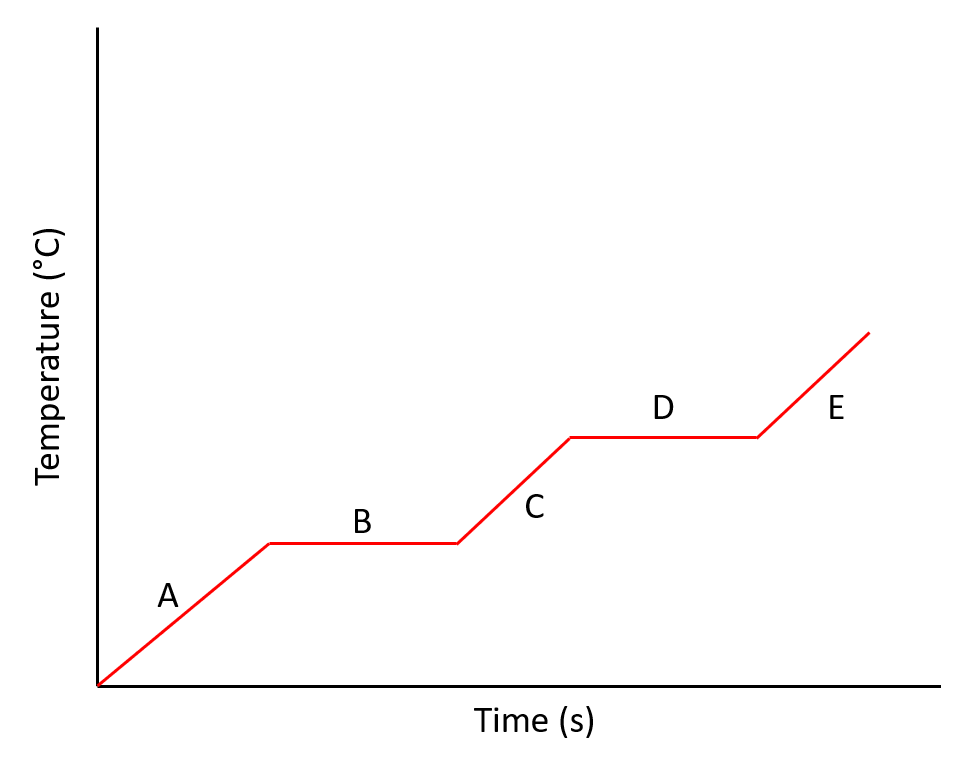
The diagram shows a heating curve for ice. Which line represents the ice melting?
A
B
C
D
E
The diagram shows a heating curve for ice. Which line represents the ice in a liquid state (water)?
A
B
C
D
E

The diagram shows a cooling curve for ice. Which line represents the ice in a liquid state (water)?
A
B
C
D
E
The diagram shows a cooling curve for ice. Which line represents the ice freezing?
A
B
C
D
E
The diagram shows a cooling curve for ice. Which line represents the ice in a solid form?
A
B
C
D
E
Sam placed a glass of water in the refrigerator. After about an hour he took it out and found it to be colder.
What is the most likely thing that happened?
the cold that was in the refrigerator transferred into the water
the particles in the water started to move faster
the cold from the refrigerator radiated into the glass
the heat that was in the water transferred out into the refrigerator

What is melting?
a gas turns into a liquid
a liquid turns into a gas
a solid turns into a liquid
a liquid turns into a solid
What is evaporation?
a gas turns into a liquid
a liquid turns in to a gas
a solid turns into a liquid
a liquid turns into a solid
What is freezing?
a gas turns into a liquid
a liquid turns into a gas
a solid turns into a liquid
a liquid turns into a solid
What is condensation?
a gas turns into a liquid
a liquid turns into a gas
a solid turns into a liquid
a liquid turns into a solid
Which of the following best explains why the sand at the beach is hotter than the water?
Sand has a higher specific heat than water.
Sand has a lower specific heat than water.
There is more water than sand at the beach.
There is more sand than water at the beach.

