

wayground logo

Free Printable Worksheets

Font size

S
M
L
XL
Worksheets

Metabolism and enzymes

Total questions: 22

Worksheet time: 28mins
Name
Class
Date
1.
What is a substance called if it speeds up a chemical reaction?
a)
reusable
b)
catalyst
c)
specific
d)
fragile
2.
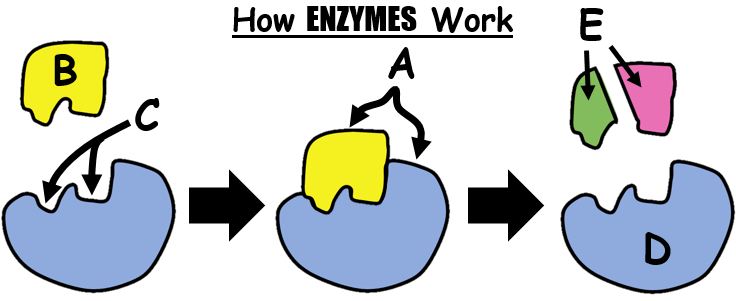
In the diagram, what is letter A? 
a)
product
b)
substrate
c)
enzyme-substrate complex
d)
active site
3.
Enzymes are...
a)
nucleic acids
b)
proteins
c)
lipids
d)
carbohydrates
4.
What is the function of an enzyme?
a)
enzymes break themselves into small pieces
b)
enzymes slow down chemical reactions
c)
enzymes speed up chemical reactions
d)
enzymes combine products to form reactants 
5.
With what 3 letters do enzymes typically end?
a)
-ose
b)
-ase
c)
-ese
d)
-tic
6.
Where do substrates bind on an enzyme?
a)
voltage-gated channels
b)
surface receptor
c)
calcium channels
d)
active site
7.
The "lock and key hypothesis" attempts to explain the mechanism of?
a)
Vacuole formation
b)
Pinocytosis
c)
Sharing of electrons
d)
Enzyme specificity 
8.
Which substrate would this enzyme catalyze?
a)
Δ
b)
σ
c)
d)
μ
9.
What makes an enzyme substrate specific?
a)
Size
b)
Shape
c)
Name
d)
Location it is found in
10.
How do enzymes increase the speed of chemical reactions?
a)
reducing the number of products   
b)
reducing the activation energy
c)
increasing the temperature of the cell
d)
increasing the concentration of reactants 
11.
After the enzyme and substrate bind together and perform the reaction, what does the substrate become?
a)
a substrate
b)
an enzyme
c)
a product
d)
an active site
12.
Which chemical is classified as an enzyme?
a)
Galactose
b)
Lipid
c)
Protease
d)
Manganese dioxide
13.
What is indicated by letter A?
a)
enzyme
b)
product
c)
substrate
d)
active site
14.
How do competitive inhibitors affect enzymes?
a)
It binds to the active site, blocking the substrate
b)
It changes the shape of the enzyme
c)
It increases the activation energy
d)
It decreases the activation energy
15.

Reactions that build up molecules

a)

catabolic reaction

b)

anabolic reaction

c)

thermal expansion

d)

reactants and products

16.

Reactions that break down molecules

a)

anabolic

b)

burning

c)

catabolic

d)

thermal

17.

Combination of anabolic and catabolic reactions

a)

metastasis

b)

anacatabolism

c)

catabolism

d)

metabolism

18.

Biological catalysts speed up reactions are unchanged by the reaction

a)

firestarters

b)

products

c)

enzymes

d)

fuel

19.

Molecule the enzyme works on

a)

substrate

b)

product

c)

solvent

d)

enzyme

20.

Activation energy

a)

increases the amount of product

b)

increased using a catalyst

c)

lowered using a catalyst

d)

lowers the amount of product

21.

Maltase is the enzyme that breaks apart

a)

maltose

b)

lactose

c)

sucrose

d)

Peptidase

22.

Lactose + water --> glucose + galactose


Activation energy in this reaction is lowered when lactase presents. What is the function of the activation energy?

a)

Break the bond in lactose

b)

Break the bond in glucose and galactose

c)

Build the bond in lactose

d)

Build the bond in glucose and galactose
