Wayground logo

Free Printable Worksheets

Font size

S
M
L
XL
Worksheets

Malthusian Theory and Population Growth

Total questions: 18

Worksheet time: 19mins

Name
Class
Date
1.

1. In Malthus’ 1798 book suggests there are diminishing returns to and a fixed amount of land. It follows in his argument that growing populations will eventually _____________________________. *

a)

shrink as the land will not produce enough food to support the population’s needs

b)

grow further as people switch from farming to fishing in oceans

c)

stagnate

2.

2. In general, the predictions of the Malthusian model have shown to be ___________________ during recent history.

a)

100% true

b)

relevant to a certain extent, particularly for less economically developed countries

c)

relevant to only more economically developed countries

d)

100% incorrect

3.

The largest number of individuals of a population that the environment can support is known as...

a)

carrying capacity

b)

population crash

c)

lag phase

d)

mutualism

4.
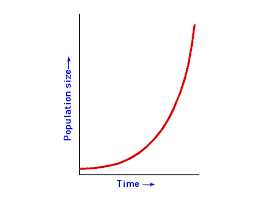
What type of growth is shown in the diagram?
a)
exponential growth
b)
logistic growth 
c)
predator-prey cycle
d)
boom-bust curve
5.
What point on the graph represents the carrying capacity?
a)
A
b)
B
c)
C
d)
D
6.
Thomas Malthus developed his ideas before the Industrial Revolution.
a)
True
b)
False 
7.
According to Thomas Malthus _______ increases the death rate.
a)
Negative checks 
b)
Positive checks
c)
Birth rate
d)
Life expectancy
8.
In comparing Malthus's theory to actual world food production and population growth during the past half-century, the principal difference is that:
a)
actual food production has been much higher than Malthus predicted.
b)
actual population growth has been much higher than Malthus predicted.
c)
Malthus's theory predicted much higher population growth than has actually occurred.
d)
population increased geometrically while food production increased arithmetically.
9.
What was his book called?
a)
An essay of my theory
b)
An essay on food production
c)
An essay on the world
d)
An essay on the principals of population
10.
Which of the following disproved his theory?
a)
End of the Malthusian theory
b)
Malthusian Trap
c)
Green Revolution
d)
Blue Revolution
11.

Why was his theory deemed 'a failure' by critics?

a)

He didn't think about it enough

b)

He failed to look at technological advances

c)

He didn't have the materials to continue his studies

d)

He couldn't prove it

12.
Is war a positive or preventative check?
a)
Preventative
b)
Positive
13.
According to Thomas Malthus _______ increases the death rate.
a)
Negative checks 
b)
Positive checks
c)
Birth rate
d)
Life expectancy
14.
Thomas Malthus concluded that
a)
population increased arithmetically while food production increased geometrically.
b)
the world's rate of population increase was higher than the development of food supplies.
c)
moral restraint was producing lower crude birth rates.
d)
population growth was outpacing available resources in every country.
15.
In comparing Malthus's theory to actual world food production and population growth during the past half-century, the principal difference is that
a)
actual food production has been much higher than Malthus predicted.
b)
Malthus's theory predicted much higher food production than has actually occurred.
c)
actual population growth has been much higher than Malthus predicted.
d)
Malthus's theory predicted much higher population growth than has actually occurred.
16.

Generally refers to people with the same basic concerns as Malthus regarding population growth, but they have adapted their ideas to be 'relevant' to the 21st Century

a)

John Paul

b)

Theory of non-existance

c)

Neo-Malthusians

17.

A large increase in crop production in developing countries achieved by the use of fertilizers, pesticides, and high-yield crop varieties.

a)

Green Revolution

b)

Blue Revolution

c)

Sustainable Development

d)

Malthusian Theory

18.

The time of intense growth in the worldwide aquaculture industry from the mid-1960s to present.

a)

Blue Revolution

b)

Global Warming

c)

Green Revolution

d)

Globalization