
 Worksheets
Introduction to Environmental Science
Total questions: 20
Worksheet time: 17mins
Environmental science is the study of the interaction of humans with the environment. Which of these would NOT be included as part of the environment?
What is the soil made of
Animals and plants is the region and surrounding area
The average temperature, wind, precipitation, and other climate factors.
All of these would be considered a part of the environment
One of the three major environmental problems is resource depletion. Which is a major contributing factor to this problem?
Developing countries have a much higher rate of resource consumption than others.
Developed countries have a much higher rate of resource consumption than others.
The human population overall is too small.
Each country uses approximately the same amount of resources.
Trees are considered ________________ resources because they will eventually regrow, given enough time.
renewable
nonrenewable
inexhaustible
recyclable
An example of an inexhaustible resource would be:
sunlight
coal
iron ore
soil
Which example best illustrates the point behind the Tragedy of the Commons essay?
Various nations overfishing in international waters, leading to a collapse of fish stocks.
A property owner clear-cutting all of the trees on his land to sell for timber.
A farmer that overplants his fields one year, leading to a poor harvest.
One country declaring war on another.
1. Sustainability is defined as…
Consuming at a rate to satisfy the current generation.
Rapidly increasing resource consumption over time.
Maintaining a rate of resource consumption that will allow the population to survive indefinitely.
Not consuming any resources at all.

An average person from _______________ would be expected to have a higher ecological footprint than the other two countries.
Country "A"
Country "B"
Country "C"
None of the above; They would have roughly equal ecological footprints.
Which government agency is responsible for enforcing laws such as the Clean Air Act and Clean Water Act?
The FDA
The IRS
The EPA
The NRA
What is made up of all the living and nonliving things which an organism interacts with?
Atmosphere
Water Supply
Environment
Soil
What is one way that factories cause pollution?
dumping chemicals into rivers and lakes
driving cars
eating too much pizza
building too many fires
What is Earth overshoot day?
The day when humanity has exhausted nature's budget for the year
The day when the Earth goes past its expected orbital path around the Sun.
Earth day
The day when Earth has reached its carrying capacity
A statement made about a population for testing purpose is called?
Statistic
Hypothesis
Level of Significance
Test-Statistic
Which of these can change when new evidence is presented?
theory
law
Which of these describes a natural phenomenon or relationship that always occurs under specific conditions
theory
law
What is the point of a feedback loop?
To provide the body with more energy
To provide the body with more food
To make sure the conditions in the body are always changing
To make sure the conditions in the body remain stable
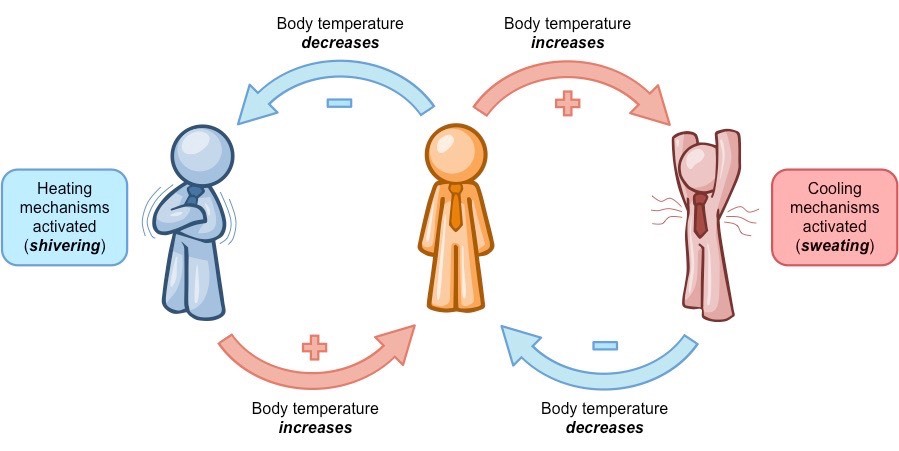
In this body temperature feedback loop, predict what would happen if cooling mechanisms were NOT activated?
The body would not warm up.
The body would not cool down.
Your body would get colder and colder.
Your body would release lots of heat.

