
 Worksheets
Class10_Reflection_d0.5 cbse
Total questions: 149
Worksheet time: 2hrs 18mins
Why can you see most objects?
In order to see a picture it must
produce light
reflect light
absorb light
According to the laws of reflection, if i = angle of incidence and r = angle of reflection,

Which diagram represents diffuse reflection?
A
B
C
D
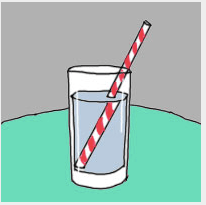
Why does the straw appear to be bent?
light is reflected
light is absorbed
light is turned
light is refracted

What is the best explanation for Mickey seeing himself in the mirror?
refraction
absorbed
reflection
flipped

Is this a reflection over the x-axis or y-axis
X-axis
Y-axis

Is this a reflection over the X-axis or Y-axis
X axis
Y axis


The picture shows which type of reflection?
Specular
X-ray
Diffuse
Normal
A ray of light is incident on a plane mirror and the angle of incidence is 25 degrees. What is the angle of reflection?
A. 0 degrees
B. 50 degrees
C. 90 degrees
D. 25 degrees

Given that the angle of incidence = 30 degrees
Which is the correct diagam?
A
B
C
D
What word is used to describe light as it strikes a smooth, shiny surface and bounces off?
shadow
energy
reflection
wave length
An object is placed 20 cm in front of a plane mirror. The mirror is moved 2 cm towards the object. The distance between the positions of the original and final images seen in the mirror is:
2 cm
4 cm
10 cm
22 cm
A ray of light that strikes a plane mirror PQ at an angle of incidence of 30o, is reflected from the plane mirror and then strikes a second plane mirror QR placed at right angles to the first mirror. The angle of reflection at the second mirror is:
30°
45°
60°
90°
An object is placed at 100 mm in front of a concave mirror which produces an upright image (erect image). The radius of curvature of the mirror is:
Less than 100 mm
Between 100 mm and 200 mm
Exactly 200 mm
More than 200 mm
Which position of the object will produce a magnified virtual image, if a concave mirror of focal length 15 cm is being used?
10 cm
20 cm
30 cm
35 cm
A ray of light is travelling in a direction perpendicular to the boundary of a parallel glass slab. The ray of light:
Is refracted towards the normal
Is refracted away from the normal
Is reflected along the same path
Does not get refracted
Focal length of plane mirror is
At infinity
Zero
Negative
None of these
Image formed by plane mirror is
Real and erect
Real and inverted
Virtual and erect
Virtual and inverted
A concave mirror gives real, inverted and same size image if the object is placed
At F
At infinity
At C
Beyond C
Power of the lens is -40, its focal length is
4m
-40m
-0.25m
-25m
In optics an object which has higher refractive index is called
Optically rarer
Optically denser
Optical density
Refractive index
The optical phenomena, twinkling of stars, is due to
Atmospheric reflection
Total reflection
Atmospheric refraction
Total refraction
Convex lens focus a real, point sized image at focus, the object is placed
At focus
Between F and 2F
At infinity
At 2F
The unit of power of lens is
Metre
Centimetre
Diopter
M-1
The radius of curvature of a mirror is 20cm the focal length is
20 cm
10 cm
40 cm
5 cm
An object is placed 20 cm in front of a plane mirror. The mirror is moved 2 cm towards the object. The distance between the positions of the original and final images seen in the mirror is:
2 cm
4 cm
10 cm
22 cm
A ray of light that strikes a plane mirror PQ at an angle of incidence of 30o, is reflected from the plane mirror and then strikes a second plane mirror QR placed at right angles to the first mirror. The angle of reflection at the second mirror is:
30o
45o
60o
90o
A ray of light is travelling in a direction perpendicular to the boundary of a parallel glass slab. The ray of light:
Is refracted towards the normal
Is refracted away from the normal
Is reflected along the same path
Does not get refracted
If an object is placed 21 cm from a converging lens, the image formed is slightly smaller than the object. If the object is placed at a distance of 19 cm from the lens, the image formed is slightly larger than the object. The approximate focal length of the lens is:
20 cm
18 cm
10 cm
5 cm

A student does the experiment on tracing the path of a ray of light passing through a rectangular glass slab for different angles of incidence. He can get a correct measure of the angle of incidence and the angle of emergence by following the labelling indicated in figure:
A
B
C
D

A student traces the path of a ray of light passing through a rectangular slab for three different values of angle of incidence (∠i ) namely 30o, 45o and 60o. He extends the direction of incident ray by a dotted line and measures the perpendicular distance ‘l’ between the extended incident ray and the emergent ray.
He will observe that:
‘l’ keeps on increasing with increase in angle of incidence
‘l’ keeps on decreasing with increase in angle of incidence
‘l’ remains the same for all three angles of incidence
‘l’ is the maximum for ∠i = 45o and is less than this value for ∠i = 30o and ∠i = 60o
Which of the following mirror is used by a dentist to examine a small cavity?
Convex mirror
Plane mirror
Concave mirror
Combination of convex and concave mirror
An object at a distance of 30 cm from a
concave mirror gets its image at the same point. The focal length of the mirror is
– 30 cm
30 cm
– 15 cm
+15 cm
If a man’s face is 25 cm in front of concave shaving mirror producing erect image 1.5 times the size of face, focal length of the mirror would be
75 cm
25 cm
15 cm
60 cm
The refractive index of water is 1.33. The speed of light in water will be
1.33 × 10⁸ m/s
3 × 10⁸ m/s
2.26 × 10⁸ m/s
2.66 × 10⁸ m/s
You are given three media A, B and C of refractive index 1.33, 1.65 and 1.46. The medium in which the light will travel fastest is
A
B
C
equal in all three media
The bending of light is called...
a rainbow
refraction
reflection
absorption
which of the following is not a property of the image formed by a [lane mirror?
virtual and erect
Object size = image size
object distance = image distance
Real and inverted
Which of the following is a concave mirror?


which of the following ray diagrams is correct for the ray of light incident on a concave mirror as shown in the figure 10.6?
A
B
C
D
Convex mirror is also called as
converging mirror
diverging mirror
plane mirror
silver mirror
The relation between focal length and radius of curvature is
R = 2f
1/f = 2R
f = R/2
R = 2/f
The point on the spherical mirror at the middle of the surface is called
focus
centre of curvature
pole
radius of curvature
A convex mirror has a focal length 12 cm. Then its radius of curvature is ........ cm
24
12
6
1.2
When the object is in between the centre of curvature (C) and focus (F) of a concave mirror, then the position of the image is ...........
At focus
At the centre of curvature
at infinity
beyond the centre of curvature

Which mirror is shown in the figure?
convex mirror
concave mirror
plane mirror
silver mirror
When the object is at infinity, a point sized image is formed at ................ by the convex mirror
focus behind the mirror
focus in front of the mirror
radius of curvature
principal axis
The image formed by a concave mirror when the object is placed between the pole and the focus is ......
virtual, erect and magnified
virtual, erect and diminished
real, inverted and magnified
real, inverted and diminished
The angle of incidence of a ray of light passing through the centre of curvature of a concave mirror is ........... degree
105
180
90
0
Where will be the images of the Sun or the moon are formed by a concave mirror?
Focus
Pole
centre of curvature
beyond centre of curvature
What is the size of the image formed when an object is kept at the focus in front of concave mirror?
enlarged
diminished
highly enlarged
highly diminished

What is the value of the unknown angle (theta) in the following diagram?
A mirror always form diminished image irrespective of the position of the object in-front of it , then the mirror is :-
Plane mirror
concave mirror
convex mirror
not possible
When light goes from one material(medium) to another it becomes bent, what term means bent?
reflected
refracted
absorbed
turned
Why does the straw appear to be bent?
light is reflected
light is absorbed
light is turned
light is refracted
When light passes from air to water, what happens to the speed of the light?
speeds up
slows down
stays the same
Which of the following factors contributes to the bending of light?
Change of speed of light
Change of density of light
Change of colour of light
Change of energy of light
flint glass n=1.70
barium glass n=1.60
crown glass n=1.523
water n=1.33
diamond n=2.45
When the light passes out of the glass, back into the air
It bends away from the normal
It does not bend
It bends towards the normal
It continues to be the normal
The angle of incidence for a ray of light having zero reflection angle is :-------
00
300
450
900
The image formed by concave mirror is real, inverted and of the same size as that of the object. The position of object should be : ----------
at the focus
at the centre of curvature
between focus and centre of curvature
beyond centre of curvature
An object at a distance of 30 cm from a
concave mirror gets its image at the same point. The focal length of the mirror is _________
– 30 cm
30 cm
– 15 cm
15 cm
A virtual image formed by a mirror of an object which is less than the size of an object . Name the mirror_______
Concave Mirror
Convex Mirror
Plane Mirror
Both Concave and Convex
The type of mirror used in reflector in automobile lights is
Plane mirror
Concave mirror
Convex mirror
None of the above
A mirror having focal length –15 cm is _________________
Plane mirror
Concave mirror
Convex mirror
None of these
Assertion: For observing the traffic at the hairpin bend in the mountains a plane mirror is preferred over convex or concave mirror.
Reason: A convex mirror has a much larger field view than a plane mirror or a concave mirror.
Both Assertion and Reason are true and Reason is the correct explanation of Assertion.
Both Assertion and Reason are true but Reason is not the correct explanation of Assertion.
Assertion is true but Reason is false.
Assertion is false but Reason is true.
Which of the following characteristics are correct for the image formed in a plane mirror?
I. Upright
II. Inverted
III. Real
IV. Same size as the object
V. Virtual
I, II, III
I, III, IV
I, IV, V
III, IV, V
No matter how far you stand from a spherical mirror, your image appears erect. The mirror may be
only plane
only concave
either plane or convex
only convex
A positive sign in the value of magnification indicates that the image is
real
virtual
enlarged
near
A ray of light is travelling from a rarer medium to a denser medium. While entering the denser medium at the point of incidence, it
goes straight into the second medium
bends towards the normal
bends away from the normal
does not enter at all
If the image is formed in front of the mirror, then the image distance will be
positive or negative depending on the size of the object
neither positive nor negative
positive
negative
A spherical mirror and a thin spherical lens have focal length of −20 cm. The mirror and lens will be:
both concave
mirror is concave and lens is convex
both convex
mirror is convex and lens is concave
A small air bubble in a glass block when seen from above appears to be raised because of
refraction of light
reflection of light
reflection and refraction of light
none of the above
To get real magnified image in convex lens, the object position is
in between lens and F
in between F and 2F
at 2F
beyond 2F
Centre point of a lens is called (a)

If a capital letter R is seen in an ordinary mirror, what does it look like?
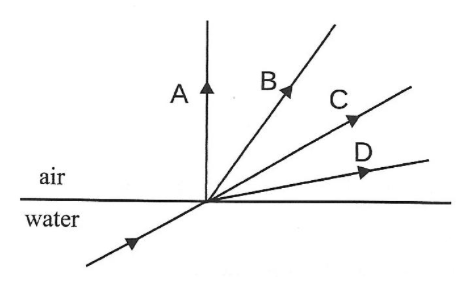
A light ray is incident from water to air. Which of the refracted rays is correct?
A
B
C
D

A mirror is titled at an angle of 20°. A light ray is incident at the surface of a plane mirror at an angle of 20°.
What is the angle of reflection?
20°
40°
50°
70°

The diagram shows a patient having her eyes tested. A chart with letters on it is placed behind her and she sees the chart reflected in a plane mirror.
How far away from the patient is the image of the chart?
2 m
4 m
5 m
7 m

Which block is made from the material with a refractive index of 1.52?
A
B
C
D
Laws of reflection of light are similar to the laws of reflection of sound
True
False
Which mirror is used as a make-up mirror ?
Convex mirror
plane mirror
concave mirror
plano-concave
Which word means to bend light rays toward each other?
Converging light
Diverging light
Virtual Light
Real Light
An object of size 5 cm is kept 20cm away from a concave mirror of focal length 15 cm . Size of its image shall be
+ 5 cm
- 10 cm
- 15 cm
- 5 cm
Value of Magnification (m) of a mirror is always + 1 , then the mirror is definitely
a concave mirror
a plane mirror
a convex mirror
none of the above
Value of Magnification (m) of a mirror is always + 1 , then the mirror is definitely
a concave mirror
a plane mirror
a convex mirror
none of the above

What causes the formation of a rainbow?
Light travels in a straight line
Reflection of light
Refraction of light
Light in bounced in two different mediums

A real image having a size of 10 cm is formed by a concave mirror. The size of the object is 5 cm.The magnification of the object is
-1/2
1/2
2
-2
An object is placed at a certain distance from a convex mirror. What is the possible magnification of the image of this object?
+0.7
+ 1.2
-1.6
-0.4

Reflections over the x-axis change the __________.
y-coordinate
x-coordinate
The magnification produced by a convex mirror is always positive. This is because
Convex mirror is a small mirror.
Image formed by a convex mirror is always smaller in size than the object.
Image formed by a convex mirror is real.
Image formed by a convex mirror is always virtual and erect.
In which of the following, the image of an object placed at infinity will be highly diminished and point sized?
Concave mirror only
Convex mirror only
Plane mirror only
Both plane and convex mirror
A child is standing in front of a magic mirror. She finds the image of her head bigger, the middle portion of her body of the same size and that of the legs smaller. The following is the order of combinations for the magic mirror from the
top.
Plane, convex and concave
Convex, concave and plane
Concave, plane and convex
Convex, plane and concave
The laws of reflection hold good for
plane mirror only
concave mirror only
convex mirror only
all mirrors irrespective of their shape
Rays from Sun converge at a point 15 cm in front of a concave mirror. Where should an object be placed so that size of its image is equal to the size of the object?
15 cm in front of the mirror
30 cm in front of the mirror
between 15 cm and 30 cm in front of the mirror
more than 30 cm in front of the mirror
A positive magnification greater than unity indicates
real image
virtual image
neither real not virtual image
distorted image
An image that forms where light seems to come from a point but light rays don't actually meet is a
virtual image
real image
inverted image
clear image
Light travels through air, water, glass and many other materials. What path does it travel to get from one place to another?
sideways
back and forth
straight
up and down
Why doesn’t the surface of a wooden boat reflect light as the surface of water does?
because the boat’s surface is rough and absorbs more light
because the surface of the boat is red, not blue
because the boat is not a natural object like the water is
because the boat is on top of the water’s surface

Which is the right diagram for a translucent material?


Which is the right diagram for an opaque material?
Which one of these shows refraction?
Which is the right diagram for a transparent material?
When does refraction occur?
Whenever light interacts with a material
At the interface between two transparent materials
At the interface between any two materials
When light hits an opaque object
Which of the following statements is not true?
Objects that absorb light cannot transmit it
We can only see objects that have reflected light
Transparent objects transmit all light that reaches them
Translucent objects can transmit light.
When light passes from a less dense material to a more dense material (e.g. air to glass) light bends:
Away from the normal
Towards the normal
Into the normal
Away from the surface (reflects)
An object at a distance of 30 cm from a concave mirror gets its image at the same point. The focal length of the mirror is
-30cm
30cm
-15cm
15cm
The angle between incident ray and refracted ray on plane mirror is 700 ,the angle of incident is
700
350
300
200
A concave mirror of focal length 20 cm forms an image having twice the size of object. For the virtual position of object, the position of object will be at
25cm
10cm
40cm
20cm
. If a man’s face is 25 cm in front of concave shaving mirror producing erect image 1.5 times the size of face, focal length of the mirror would be
75cm
25cm
150cm
50cm
As light travels from a rarer to a denser medium it will have
increased velocity
decreased velocity
No change in velocity
Non of the adove
The angle of incidence i and refraction r are equal in a transparent slab when the value of i is
00
900
450
600
The refractive index of transparent medium is greater than one because
Speed of light in vacuum < speed of light in tansparent medium
Speed of light in vacuum > speed of light in tansparent medium
Speed flight in vacuum = speed of light in tansparent medium
Frequency of light wave changes when it moves from rarer to denser medium
The refractive index of glass is 1.5. The speed of light in glass will be ( speed of light in free space is 3x10⁸m/s.)
2x10⁸m/s
3.5x10⁸m/s
4.5x10⁸m/s
2.25x10⁸m/s
A divergent lens will produce
always real image
always virtual image
both real and virtual image
none of these
Magnifying power of a concave lens is
always > 1
always < 1
always =1
can have any value
. If the power of a lens is – 2 D, what is its focal length?
-0.2m
-100cm
-50cm
-0.5cm
A full length image of a distant tall building can definitely be seen by using
a concave mirror
a convex mirror
a plane mirror
both concave as well as plane mirror
A concave mirror produces a magnification of +4. The object is placed:
At the focus
Between focus and centre of curvature
Between focus and pole
Beyond the centre of curvature
The magnification power of plane mirror
one
infinite
less then one
more then one
An object is placed 20 cm in front of a plane mirror. The mirror is moved 5 cm towards the object. The distance between the positions of the object and final images seen in the mirror is:
10 cm
5 cm
30 cm
15 cm
What is light? (Choose a complete answer)
It´s a type of energy.
It´s a form of energy that moves in straight lines.
It travels in straight lines.
It´s the sun.
When you look at your face in a flat mirror, where does your face appear to be?
A. an equal distance behind the mirror to what you are in front
B. a long way behind the surface of the mirror
C. on the surface of the mirror
D. just in front of the mirror
What is meant when we say light is transmitted?
Light travels through something
Light bounces off of something
Light bends when it hits something
Light is scattered

