
 Worksheets
Chemical Reactions and Chemical Changes
Total questions: 25
Worksheet time: 29mins
Which of the following are the examples of synthesis? Select all that apply.
Na + Br2 → NaBr
KClO3 → KCl + O2
HgO + Cl2 → HgCl + O2
Cl2 + NaBr → NaCl + Br2
Ca + I2 → CaI2
Predict the product:
Mg + N2 → ?
Mg3N2
MgN
Mg2N3
MgN2
Mg2N
Choose the balanced chemical equation for the formation of iron oxide when iron is left exposed to moist air.
2Fe + O2 → 2FeO
3Fe + 2O2 → Fe3O4
4Fe + 3O2 → 2Fe2O3
4Fe + O2 → 2FeO2
Al(OH)3 → Al2O3 + H2O
Copper (II) carbonate → ___________ + carbon dioxide
copper (I) oxide
copper (II) oxide
copper
None of the above
Metal hydroxide (+ heat) → ____________ + _________
metal carbonate + water
metal oxide + carbon dioxide
carbon dioxide + water
metal oxide + water
A nitrate which on decomposition does not release reddish brown gas.
Calcium nitrate
Cupric nitrate
Magnesium nitrate
Potassium nitrate
A nitrate which on decomposition does not leave any residue.
Ammonium Nitrate
Sodium nitrate
Zinc nitrate
Silver nitrate
A compound which on decomposition produces a basic and an acidic gas.
Phosphorus pentachloride
Ammonium chloride
Potassium chlorate
Aluminium chloride
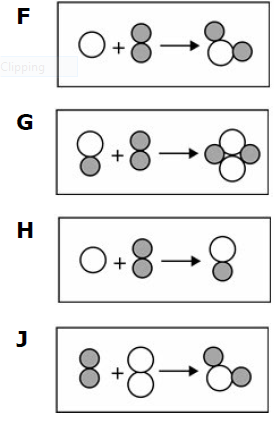
Balancing the following:
____ Al + ____ HCl → ____ AlCl3 + ____ H2
What is the general reaction scheme for a single replacement reaction?
A + B --> AB
AB --> A + B
A + CD --> C + AD
AB + CD --> CB + AD
CxHy+O2 −> CO2+H2O
Photosynthesis is a chemical reaction that involves the production of glucose (sugar) from carbon dioxide and water in the presence of sunlight. Photosynthesis is what kind of reaction?
Exothermic
Endothermic
Decomposition
Direct Combination
Which type of reaction is this:
2AgNO3 ---> 2Ag + 2NO2 + O2
Electrochemical Reaction
Catalytic Reaction
Photochemical Reaction
Thermal Dissociation
A carbonate which does not decompose on heating.
Potassium carbonate
Magnesium carbonate
Calcium carbonate
Zinc carbonate
What would be the colour of the resulting solution, when iron reacts with blue coloured copper sulphate solution?
Red
Green
Blue
White
The acid anhydride of sulphuric acid.
SO3
SO2
CO2
NO2
The metal hydroxide which on decomposition forms a metal oxide which is yellow when hot and white when cold.
Ca(OH)2
Cu(OH)2
Pb(OH)2
Zn(OH)2
Identify which type of reaction is this:
BaCl2 + Na2SO4 ----> BaSO4 + 2NaCl
Neutralisation Reaction
Precipitation Reaction
Decomposition Reaction
Displacement Reaction
The gas which liberates when zinc reacts with dilute hydrochloric acid.
Sulphur dioxide
Carbon dioxide
Hydrogen
Hydrogen sulphide
Which of the following are exothermic processes?
(i) Reaction of water with quick lime
(ii) Combustion of Methane gas
(iii) Evaporation of water
(iv) Sublimation of camphor (crystals)
(i) and (ii)
(ii) and (iii)
(i) and (iv)
(ii) and (iv)
2HNO3 + Ca(OH)2 → Ca(NO3)2 + 2H2O; is an example of
(i) displacement reaction
(ii) double displacement reaction
(iii) neutralisation reaction
(iv) combination reaction.
(i) and (ii)
(ii) and (iii)
(iii) and (iv)
(i) and (iv)

