
 Worksheets
Ecosystems and Energy Flow
Total questions: 50
Worksheet time: 47mins
In an ecosystem, snakes feed on frogs, which feed on mosquitoes. Use of a bug spray has decreased the number of mosquitoes. What will probably happen to the number of frogs and snakes?
Frogs will increase, snakes will increase
Frogs will increase, snakes will decrease
Frogs will decrease, snakes will increase
Frogs will decrease, snakes will decrease
Which of these shows a possible food chain for an ecosystem?
shark--> fish --> plankton -->sun
sun --> plankton --> fish --> shark
plankton --> sun --> fish --> shark
plankton --> fish --> shark --> sun

If the snake population decreased, which group would increase in number?
Producers
Primary consumers
Secondary consumers
Tertiary consumers
Decomposers

A raccoon eats plants and animals. It is an example of a(n)
omnivore
carnivore
herbivore
decomposer
What do producers need, other than sun, for photosynthesis?
Water and CO2
Glucose and O2
Love and happiness
Carbohydrates and water
Organisms that make their own food
Producer
Consumer
Decomposer
Organisms that obtain energy by feeding on other organisms
Producer
Consumer
Decomposer
Organisms that break down wastes and dead organisms and return the raw materials to the environment
Producer
Consumer
Decomposer
Consumers that eat only plants
Carnivores
Omnivores
Herbivores
Scavengers
Consumers that eat only animals
Carnivores
Omnivores
Herbivores
Scavengers
Consumers that eat both plants and animals
Omnivores
Carnivores
Herbivores
Scavengers
A food _______ is a series of events in which one organism eats another and obtains energy.
chain
web
pyramid
plate
A food _______ consists of many overlapping food ________.
web, chains
chain, webs
pyramid, webs
web, pyramids
As you work your way up the energy pyramid, what happens to the energy?
It increases
It decreases
It stays the same
Nothing

In the food web above, what eats the rabbit?
Fox
Hawk
Vole
Grass

In the food web above, what organism is missing from this food chain:
Grass --> Slug --> ________ --> Hawk
Vole
Frog
Insect
Thrush

In the energy pyramid, what is the bottom level composed of?
Producers
First-Level Consumers
Second-Level Consumers
Third-Level Consumers
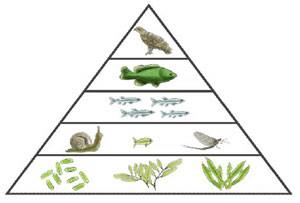
In the energy pyramid, what comes after the producers?
Producers
First-Level Consumers
Second-Level Consumers
Third-Level Consumers
An autotroph can also be called a
animal.
consumer.
heterotroph.
producer.
Consumers breakdown the macromolecules of the organisms they have eaten to release ATP in a process called
photosynthesis.
chemosynthesis.
cellular respiration.
ATP liberation.
The levels of nourishment in a food chain are called
pyramids of numbers.
trophic levels.
food phases.
biomagnitudes.
Because energy flows from organism to organism and is used for metabolism or is converted to heat the next organism in the chain only receives 10% of the energy from the previous level. This is known as the
Heat Regulation.
Energy Loss Directive.
Heat Transfer Rule.
Rule of 10.

In the picture, which organism is the primary consumer?
plant
snake
mouse
bird
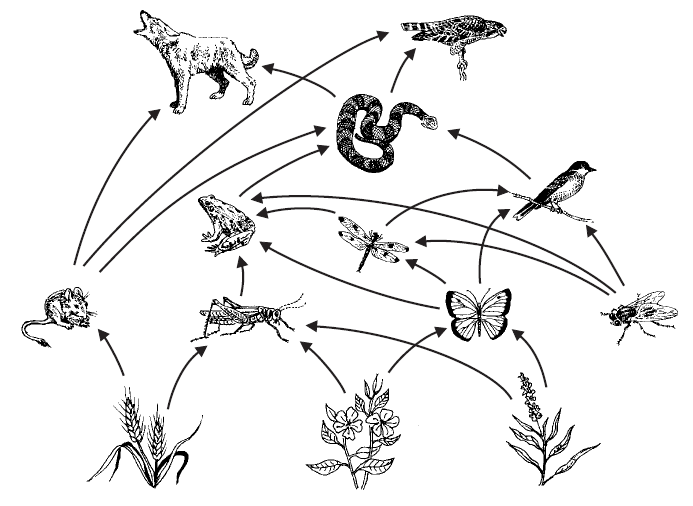
In this food web, which of the following organisms eats the largest variety of different producers?
Mouse
Grasshopper
Dragonfly
Butterfly
How much energy is available to be passed on to the next level in a food web?
100%
10%
50%
75%
Any organisms that makes its own food
autotroph
heterotroph
herbivore
Organism that must get its energy from other organisms
autotroph
heterotroph
omnivore
A system comprising all the biotic and abiotic factors in an area and all the interactions among them
Ecosystem
Environment
Tundra
Environmental Interactions
What is an ecosystem?
The area of land where animals live
A community of insects that work together
A community of organisms together with its environment
The section of a terrarium where plants grow

Non-living things
Biotic
Abiotic
Examples of Abiotic things
plants, animals fungi
light, water, soil
A place where an organism lives
Biome
Habitat
Ecosystem
All organisms in a community
Niche
Community
Population
All populations living in an area
Community
Population
Niche
The role of organisms in a community
Population
Ecosystem
Niche


