wayground logo

Free Printable Worksheets

NEW

Font size

S
M
L
XL
Worksheets

Homeostasis

Total questions: 30

Worksheet time: 30mins

Name
Class
Date
1.
What is involuntary contractions of voluntary muscles to warm up?
a)
Shivering
b)
Sweating
c)
Vasodilation
d)
Vasoconstriction
2.
What is the evaporation of a liquid to cool the body?
a)
Shivering
b)
Sweating
c)
Vasodilation
d)
Vasoconstriction
3.
Homeostasis
a)
allows for a wildly fluctuating internal environment
b)
is impossible in vertebrates
c)
is the maintenance of a relatively stable internal environment and often incorporates a form of feedback regulation
d)
is the maintenance of a relatively stable external environment and often incorporates a form of feedback regulation
4.
Homeostasis in the human body is often maintained by a: 
a)
neutral feedback loop 
b)
solar feedback loop
c)
positive feedback loop
d)
negative feedback loop
5.
Positive feedback is when the change caused by the stimulus is
a)
decreased
b)
non existant
c)
increased
d)
changes constantly
6.
When you get cut, your skin cells release hormones that signal platelets to come and stop the bleeding. Platelets then release more hormones that signal even more platelets to help stop bleeding. The hormone signals continue until the cut is closed.
a)
Positive Feedback Response
b)
Negative Feedback Loop 
7.
When you are cold, you shiver and your blood vessels contract, which warms you up. When you are hot, you sweat and your blood vessels expand, which cools you down.  
a)
Positive Feedback Response
b)
Negative Feedback Loop 
8.
Water diffusing with the concentration gradient from high water concentration to low water concentration across a cell membrane is....
a)
Facilitated Diffusion
b)
Simple Diffusion
c)
Active Transport
d)
Osmosis
9.
Which diagram represents an organ?
a)
#1
b)
#2
c)
#3
d)
#4
10.
Which is the largest structure?
a)
Cells
b)
Tissue
c)
Organ
d)
Organism
11.

What is an example of a positive feedback mechanism?

a)
b)
12.
The term for maintaining internal temperature is: 
a)
Thermoregulation
b)
Thermometer
c)
Homeothermal
d)
Homeostasis
13.
Rapid growth during puberty causes your body to release more and more growth hormones. As you grow, more and more growth hormones are released until puberty is reached, and then the hormones stop.
a)
Positive Feedback Response
b)
Negative Feedback Loop 
14.
If the calcium in your blood decreases below homeostasis levels, a gland in the brain will sense the decrease and send a chemical message to your bones. Your bones will release calcium into the blood, bringing blood calcium levels back up.
a)
Positive Feedback Response
b)
Negative Feedback Loop 
15.
These two body systems regulate feedback mechanisms.
a)
Skeletal & Muscular
b)
Skeletal & Endocrine
c)
Muscular & Nervous
d)
Endocrine & Nervous
16.
If the environment gets cold, we will often shiver in order to:
a)
keep body temperature the same as the external temperature
b)
decrease body temperature
c)
increase body temperature
d)
regulate blood pressure
17.
The tendency of an organism to maintain a balanced state in order to stay healthy.
a)
Stimuli
b)
Response
c)
Tropism
d)
Homestasis
18.

Which of the following is not regulated by homeostasis?

a)

body temperature

b)

blood sugar

c)

blood pH

d)

body movements

19.

During child birth a woman's body over produces a hormone called oxytocin until the baby is born. What kind of feedback loop would this be?

a)

Negative Feedback Loop

b)

Positive Feedback Loop

c)

Neutral Feedback Loop

d)

Linear Feedback Loop

20.

These detect changes in the environment

a)

Control Center

b)

Sensors

c)

Communication System

d)

Target

21.

This takes the messages from the sensors and is known as the control center

a)

Brain

b)

Kidney

c)

Liver

d)

Heart

22.

Osmoregulation means....

a)

maintain water levels

b)

maintain temperature

c)

maintain heart rate

d)

maintain breathing

23.
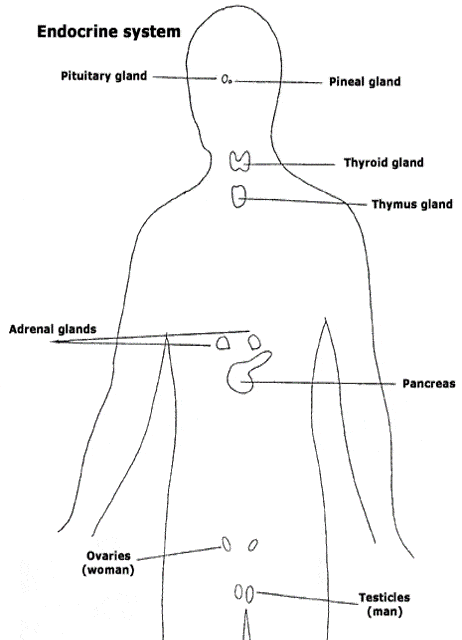
organ of the endocrine system that secretes hormones.
a)
heart
b)
gland
c)
brain
d)
skin
24.

Controls body temperature and the release of hormones.

a)

hypothalamus

b)

thalamus

c)

adrenal glands

d)

pineal gland

25.
a body system that controls growth and homeostasis by secreting hormones from glands.
a)
skeletal system
b)
nervous system
c)
endocrine sytem
d)
integumentary system
26.

What do warm-blooded animals do in order COOL OFF their body temperature?

a)

Wear a hat

b)

Cover up

c)

Sweat and pant

d)

Shiver

27.

What is an example of a cold-blooded animal?

a)

Human

b)

Skunk

c)

Frog

d)

Rabbit

28.

What is an advantage to being cold-blooded?

a)

They are more awesome

b)

They do not have to eat as much food for energy

c)

They love the cold weather

d)

They are larger than warm-blooded animals

29.

Cold-blooded animals....

a)

body temperature stays the same when it's cold or hot outside

b)

body temperature depends (changes) on whether its cold or hot outside

30.

Warm-blooded animals....

a)

body temperature stays the same when it's cold or hot outside

b)

body temperature depends (changes) on whether its cold or hot outside