
 Worksheets
Week 4 - RELATIONAL DATA MODEL
Total questions: 26
Worksheet time: 13mins
In relational data model, the total number of rows can be identified as ______________________ .
Cardinality
Degree
Attribute
Entity
Identify the total number of attributes in a relational data model.
Tuple
Entity
Degree
Cardinality

Identify the candidate key.
W
X
Y
Z
An attribute whose value is calculated (derived) from other attributes. Choose the correct attributes based on the information given.
Registration Number
IC Number
Certificates
Date of Birth
If related data exists in more than one table, they can be joined by using the Primary Key link to the same key in the other table. Identify this key.
Foreign Key
Primary Key
Candidate Key
Composite Key
In relational data model, the total number of attributes can be identified as ______________________ .
Cardinality
Degree
Tuple
Entity

Based on the figure above, identify the number of tuples that will be returned by the following relational algebra query : σ Type = 'Saving' (Account)
2
3
6
0

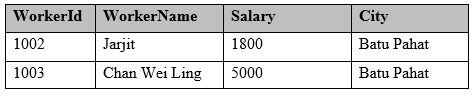
Base on the table given, identify output that will be produced when, σ Salary > 3000 ˅ City = ‘Batu Pahat’ (WORKER).





Below are the characteristics of a Relational Table EXCEPT
A table is perceived as a two-dimensional structure composed of rows and columns.
Each table row(tuple) represents a single entity occurrence within the entity set.
Each table column represents an attribute.
All values in a column may have different data format.
Attribute whose value is determined by the other attribute is called____________
Determinant
Dependant
Below are the type of key(s) available in RDBM EXCEPT
Superkey
Candidate key
Primary key
Composer key

In the table above, which one is Primary Key?
firstName
lastName
StudentID
Select is a unary operator that yields a ______________________ subset of a table.
vertical
horizontal

Referring to the original table above, if we execute project CustomerName, which result will be produced?


What operator between table Completed and DBProject that be able to produce result as in picture above?
Union
Intersect
Difference
Divide
The rule that a value of a foreign key must appear as a value of some specific table is called as
Referential constraint
Index
Integrity constraint
Domain constraint
Which of the following relational algebra operations do not require the participating tables to be union-compatible?
unioin
intersection
difference
cartesian product
Minimal Superkeys are called
Primary key
Foreign key
Candidate key
Attribute keys
Foreign key is the one in which the ________ of one relation is referenced in another relation.
Foreign key
Primary key
References
Check constraint
Which of the following is not a restriction for a table to be a relation?
The cells of the table must contain a single value.
All of the entries in any column must be of the same kind.
The columns must be ordered.
No two rows in a table may be identical.

