
 Worksheets
Biomolecules Review
Total questions: 16
Worksheet time: 6mins
Which biomolecule is responsible for storing and transmitting your hereditary information?
Carbohydrate
Lipids
Protein
Nucleic Acid
Which biomolecule includes sugars and starches?
Lipids
Proteins
Carbohydrates
Nucleic Acid
Which biomolecule includes fats, oils, and waxes?
Proteins
Nucleic Acid
Lipids
Carbohydrate
Carb-loading is a strategy that marathon runners have been known to do several days before a big race. This involves eating foods high in carbohydrates.
How does this benefit the athlete?
It increases the number of amino acids available to build muscle mass.
It increases the starches stored in the athlete's muscles.
It increases the storage of glycogen for energy in the muscles.
It increases body fat which warms and protects the muscles.
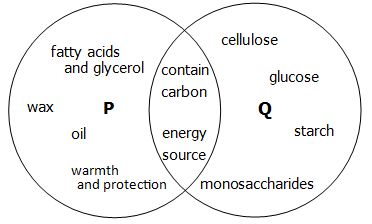
Use the Venn diagram to compare and contrast two macromolecules.
What is the best title for the letter Q?
carbohydrates
lipids
nucleic acids
proteins
Which of the following elements is not frequently found in organic compounds?
Carbon
Hydrogen
Oxygen
Chlorine
The first type of biomolecules your body will break down are
nucleic acids.
proteins.
carbohydrates.
lipids.
Which of the following is not a lipid?
steroid
cholesterol
wax
cellulose

The complex carbohydrates pictured below are made by linking molecules of glucose.
In all three complex carbohydrates, the subunits of glucose are bonded together differently. Because they have different structures, they most likely —
contain different chemical elements
form different proteins
carry different nucleotides
perform different functions

