wayground logo

Free Printable Worksheets

Font size

S
M
L
XL
Worksheets

Cell Structures and Functions

Total questions: 22

Worksheet time: 15mins

Name
Class
Date
1.
Control center; contains DNA; appeared purple under the microscope
a)
Nucleus
b)
Mitochondria
c)
Cell Membrane
d)
Vacuole
2.
Allows materials to come in and out of the cell
a)
Cell Wall
b)
Cell Membrane
c)
Vacuole 
d)
Mitochondria
3.
Uses energy from sugar to make energy for the cell
a)
Chloroplast
b)
 Mitochondria
c)
 Nucleus 
d)
Cell Membrane
4.
gel-like substance where work happens within the cell
a)
Cytoplasm
b)
Mitochondria 
c)
DNA
d)
Chloroplasts
5.
Who looked at cork and named what he saw cells?
a)
Anton van Leeuwenhoek
b)
Robert Hooke
c)
Rudolph Virchow
d)
Matthias Schleiden
6.
The organelle that looks like small dots.  It makes proteins.  
a)
nucleus
b)
cell membrane
c)
ER
d)
ribosomes
7.

Which of the following BEST describes the structure of the plasma membrane?

a)

The plasma membrane is a phospholipid bilayer, with a hydrophobic interior and a hydrophilic exterior.

b)

The plasma membrane is a protein bilayer, with a few lipids and carbohydrates scattered throughout.

c)

The main component of the plasma membrane are protein channels, which control what goes in / out of the cell.

d)

The plasma membrane is composed of several layers of carbohydrates, which control passive and active transport.

8.

The golgi apparatus is responsible for the modification of cell-produced proteins.

a)

True

b)

False

9.

The rough endoplasmic reticulum is a site for protein synthesis.

a)

True

b)

False

10.
The type of cellular transport that requires no energy.
a)
Active Transport
b)
Protein Pumps
c)
Passive Transport
d)
Endocytosis
11.
What type of transport involves the movement of water from high to low concentrations?
a)
Diffusion
b)
Active Transport
c)
Facilitated Diffusion
d)
Osmosis
12.
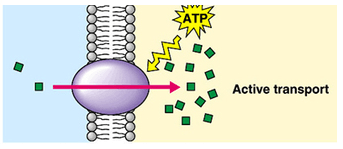
ATP is a form of energy.
a)
Passive Transport
b)
Active Transport
13.
"Water Loving"
a)
Hydrophobic
b)
Hydrophilic 
c)
Hydroelectric 
d)
Hydroloric
14.
"Water Fearing" 
a)
Hydrophobic
b)
Hydrophilic 
c)
Hydroelectric 
d)
Hydroloric
15.
What is diffusion?
a)
when molecules move 
b)
when molecules move from a high concentration to a low.
c)
no movement 
d)
molecules move everywhere
16.
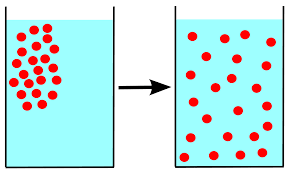
The picture below is an example of _________________.
a)
osmosis
b)
isotonic
c)
diffusion
d)
active transport
17.

The three stages of the cell cycle are __________, mitosis, and

cytokinesis.

a)

interphase

b)

anaphase

c)

metaphase

d)

prophase

18.

The ____________ ensures that our body’s grow and repair

themselves.

a)

The cell growth

b)

The cell repair

c)

The cell recycle

d)

The cell cycle

19.

The phase of mitosis when chromosomes align in the

middle is called ________

a)

anaphase

b)

prophase

c)

telophase

d)

metaphase

20.

The phase of mitosis where the nuclear membrane forms

is called ________ .

a)

anaphase

b)

prophase

c)

metaphase

d)

telophase

21.

The first phase of mitosis is called _______________ .

a)

telophase

b)

metaphase

c)

anaphase

d)

prophase

22.

The final stage of the cell cycle is called:

a)

Interphase

b)

mitosis

c)

cytokinesis

d)

daughter cells