
 Worksheets
Eduqas A Level Business - Product Life Cycle
Total questions: 15
Worksheet time: 10mins
Name
Class
Date
1.

Which one is NOT a stage in the PLC?
a)
maturity
b)
decline
c)
growth
d)
development
2.

Which stage has rapid sales?
a)
introduction
b)
maturity
c)
decline
d)
growth
3.

Which stage has lots of competitors?
a)
growth
b)
maturity
c)
introduction
d)
decline
4.

What is a product extension?
a)
longer production time
b)
products with extension features
c)
strategies to keep the product from declining
d)
products that keep going through the different stages
5.
The product life cycle shows the different stages that a product passes through and sales that can be expected at each stage
a)
True
b)
False
6.
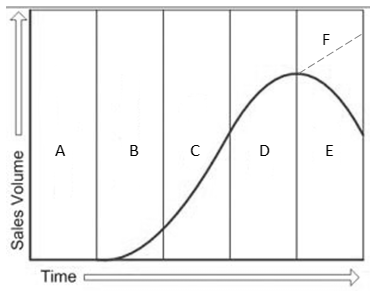
What is happening at point F on the Product Life Cycle?
a)
Introduction
b)
Decline
c)
Maturity
d)
Growth
7.
Which of these are extension strategies of a product?
a)
Cut price
b)
Modify the product
c)
All of these
d)
Special Offers
8.
Which of these comments is most suitable for Growth?
a)
Heavy investment but no sales
b)
Sales are likely to be low as the product is new to the market
c)
Revenue is increasing as the product gains popularity
d)
Likely to be characterised as a dog in the Boston Matrix
9.
Firms with a technically superior good may well engage in price skimming. This comment could apply to which stage of the Product Life Cycle?
a)
Introduction
b)
Growth
c)
Decline
d)
Maturity
10.
What happens to the cash flow of a business at the growth stage of the product life cycle?
a)
The cash flow should become more positive
b)
Cash flow is likely to be negative because money has to be spent on research and development
c)
Sales will fall and cash flow will drop
d)
There may be a need to spend money re-promoting the product. As a result, cash flow may begin to fall.
11.
Costs are incurred e.g. building new production lines, promotion and distribution costs. Likely the product will still not be profitable. The length of this stage will vary.
a)
Maturity
b)
Growth
c)
Introduction
d)
Decline
12.
In this stage:
•Low sales
•High cost per customer acquired
•Negative profits
•Innovators are targeted
•Little competition
a)
Product development
b)
Introduction
c)
Growth
d)
Maturity
e)
Decline
13.
Which one of the following is a benefit of new product development?
a)
It is cheaper to develop a new products
b)
The latest technology can be a feature of the new product
c)
Customers will always prefer newly developed products
14.
Which of the following is a true statement about the introduction stage of the product life cycle:
a)
Profits are usually nonexistent.
b)
Costs are low.
c)
c. Sales growth is exploding.
d)
There is intense competition
15.
Which of the following is a true statement about the growth stage of the product life cycle:
a)
Costs go up.
b)
Competitors arrive on the scene.
c)
It’s the longest-lasting stage of the product life cycle.
d)
Sales increase very slowly.
100 %

