wayground logo

Free Printable Worksheets

NEW

Font size

S
M
L
XL
Worksheets

Bio "Do you remember?"

Total questions: 20

Worksheet time: 15mins

Name
Class
Date
1.

A close relationship between two different species of organisms living together.

a)

Mutualism

b)

Symbiosis

c)

Competition

d)

Commensialism

2.

The nucleus is the

a)

Power house of the cell

b)

Waste collector in the cell

c)

Control center of the cell

d)

protein factory in the cell

3.
Which scientist looked at cork under a microscope and labeled the little rooms he saw, 'cells?'
a)
Hooke
b)
Leeuwenhoek
c)
Schwann
d)
Schleiden
4.

Who is considered the "father" of modern genetics?

a)

Einstein

b)

Mendel

c)

Disney

d)

Washington

5.
Who was the first naturalist to study evolution?
a)
Charles Darwin
b)
Gregor Mendal
c)
Carolus Linneaus
d)
Thomas Edison
6.
This is a process in which organisms gradually change over time.
a)
Environment
b)
Competition
c)
Evolution
d)
Fossils
7.

In the wild, some alligators gets their teeth cleaned by birds. The birds gets their food from the alligators' teeth.

What type of symbiosis is this?

a)

Mutualism

b)

Commensalism

c)

Parasitism

d)

Neutralism

8.
Glucose (sugar) is an example of a
a)
Carbohydrate
b)
Lipid
c)
Protein
d)
Nucleic Acid
9.
What word describes when water is attracted to other substances?
a)
cohesion
b)
adhesion
c)
capillary action
d)
surface tension
10.

True or False: Plants make their own food and use the energy from the food that is made.

a)

True

b)

False

11.
Antibiotics kill viruses
a)
True
b)
False
12.

Cells that lack membrane bound organelles such a nucleus are called

a)

prokaryotic

b)

eukaryotic

13.

How are bacterial cells different from plant and animal cells?

a)

Bacterial cells contain many more cell organelles.

b)

Bacterial cells contain almost no cell organelles.

c)

Bacterial cells have more complex cell organelles.

d)

Bacterial cells have well-defined nuclei.

14.
Which is the most specific classification level?
a)
Domain
b)
Kingdom
c)
Genus 
d)
Species
15.
An organism’s scientific name consists of...
a)
Domain kingdom
b)
Phylum class
c)
Family order
d)
genus species
16.
How many domains are there?
a)
1
b)
2
c)
3
17.

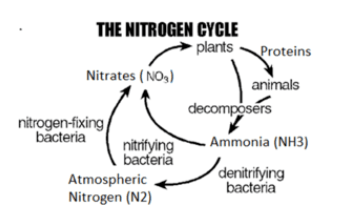
According to this diagram, plants absorb

a)

nitrates

b)

nitrogen fixing bacteria

c)

animals

d)

decomposers

18.
Ecology is?
a)
The study of human feet
b)
The study of relationships between plants, animals and their surroundings
c)
The study of bones
d)
The study of the brain
19.
A consumer?
a)
Makes its own food
b)
Eats dead plants and animals
c)
Eats plants and other animals for energy
d)
Buys toys for kids
20.

What is the image above:

a)

Chromosome

b)

Chromotid

c)

Centromere

d)

Centriole