
 Worksheets
15. Our environment
Total questions: 25
Worksheet time: 15mins
Name the chemicals of our body which help us in digestion of food.
Hormones
Enzymes
Stomach
Mouth
Which man-made material does not decompose by microbacterial reaction ?
Human flesh
Dead animal flesh
Bark of plant
Plastic
Which of the following elements does not form ecosystem ?
Non-biotic components
Biocomponents
Plastic bags
All of the above
Which of the following is an example of herbivores animal ?
Cow
Snake
Lion
Tiger
Which of the following is omni present ?
Lion
Fox
Hawk
Human being
How many atoms of oxygen are there in ozone ?
4
3
2
1
What is the nature of ozone ?
It is very poisonous
It is simple
It is fragrent
It produces purple smoke
Environment is damaged by use of paper bag.
True
False
What does a food chain always start with?
The herbivore
The carnivore
The producer
The consumer
What percentage of energy is passed on to next tropic level?
10%
50%
90%
100%

What is this called?
Food Web
Food Chain
Abiotic Factors
Biotic factors
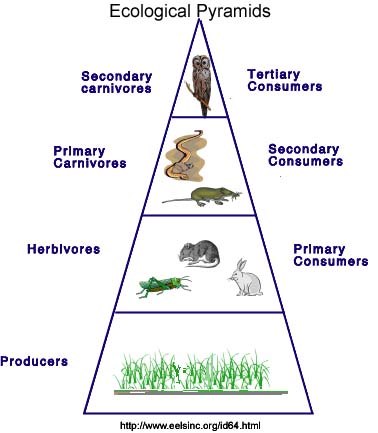
The phenomenon by which toxins concentrate in the organisms at higher trophic levels within an ecosystem is known as...
Biotoxicity
Biomagnification
Eutrophication
Predation
What does the Ozone in the atmosphere do?
causes the greenhouse effect
causes acid rain
protects the Earth from harmful infrared (IR) rays
protects the Earth from harmful ultraviolet (UV) rays
What damage can UV rays cause?
can cause sunburn.
can cause some types of skin cancer.
cataracts.
all of the above
What is causing damage to the Ozone layer?
Methane
Carbon dioxide
CFCs
All of the above
Each step in a food chain is called a
trophic level
consumer level
food web
producer
The last organism in a food chain is
producer
decomposers
parasites
none of the above
Flow of energy in a food chain is always
bidirectional
unidirectional
multidirectional
all of the above
Green plans in a terrestrial ecosystem can capture about (a) % of the energy of sunlight falls on their leaves.
Calculate the amount of energy available to snake in the given food chain if there is 6500 J of energy available to grass hopper.
Grass ----> grass hopper ---> frog -----> snake
6500 J
650 J
65 J
6.5 J
A ____ is considered a terrestrial ecosystem
Ocean
pond
underground caves
forest

