

Wayground logo

Free Printable Worksheets

Font size

S
M
L
XL
Worksheets

Unit 1 - Basic Concepts

Total questions: 29

Worksheet time: 29mins

Name
Class
Date
1.
What is the fundamental problem of every society?
a)
labor costs
b)
scarcity
c)
economic interdependence
d)
market fluctuation
2.
What is the definition of the economic term Opportunity Cost?
a)
the value of the next best alternative that is given up due to the choice you made 
b)
The price you pay to purchase something 
c)
The benefit you gain by making a decision 
d)
The amount of debt you take on by making a decision 
3.

If a point lies on the curve this means the company/country/individual is being efficient. If a point lies inside the curve, what does that tell?

a)

They are being over efficient

b)

There is an idle, or unproductive, or use of resources

c)

It is not impossible with the given resources

d)

They are still efficient, just at another point

4.
What is the production possibilities curve?
a)
a graph that shows how efficient an economy can produce a combination of 2 goods
b)
a graph that shows how much money something is
c)
a graph that shows the opportunity a country has to give up in order to lose something else
d)
a visual representation of how land, labor, capital, entrepreneurs are distributed
5.
Economic growth affects the PPF by...
a)
Shifting inward
b)
Shifting outward
c)
causing no change at all
d)
turning it into a straight line
6.
The opportunity cost of increasing production from 4 to 7 boats is
a)
1 boat
b)
2 boats
c)
2 trucks
d)
3 trucks
7.

What does point B represent?

a)

Production at greater than the country's minimum potential

b)

Production is less than the country's minimum potential

c)

Production is greater than the country's maximum potential

d)

Production at the country's maximum potential
8.
Labor, human capital, entrepreneurship, natural resources, and capital are all examples of which of the following?
a)
Outputs
b)
Substitutes in Production
c)
Absolute Advantage
d)
Factors of Production
9.
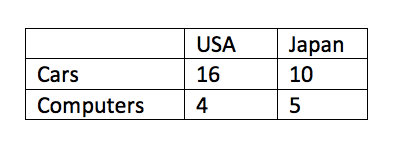
Based on the table provided, which one of the following statements is correct?
a)
Japan has the absolute advantage in producing cars
b)
Japan has the comparative advantage in producing cars
c)
The United States has the absolute advantage in producing both cars and computers
d)
The opportunity cost of producing a car in Japan is 1/2 a computer
10.
If nations specialize according to their comparative advantage and engage in trade with each other, each nation can:
a)
Consume outside its production possibilities curve 
b)
Produce outside its production possibilities curve 
c)
Shift its production possibilities curve to the right 
d)
Produce more of all goods 
11.

The ability of an individual or group to carry out a particular economic activity (such as making a specific product) more efficiently than another activity

a)

absolute advantage

b)

specialty

c)

production

d)

comparative advantage

12.
When determining comparative advantage one must determine 
a)
Opportunity cost
b)
Specialization
c)
Absolute Advantage
d)
Embargos 
13.
To focus on producing one thing to improve productivity is known as:
a)
Specialization
b)
International trade
c)
Absolute Advantage
d)
Supply and Demand
14.
This part of the market determines DEMAND
a)
buyers
b)
sellers
c)
suppliers
d)
store owners
15.
A group of buyer and sellers of a particular good or service
a)
Supply
b)
Demand
c)
Agency
d)
Market
16.
This part of the market determines SUPPLY
a)
buyers
b)
sellers
c)
consumers
d)
us
17.
For the law of demand, as price rises, what happens to quantity demanded?
a)
it goes up
b)
it goes down
c)
it stays the same
d)
it is not effected
18.
For the law of supply, as price rises, what happens to quantity supplied?
a)
it goes up
b)
it goes down
c)
it stays the same
d)
it is not effected
19.
When quantity supplied and quantity demanded is equal
a)
surplus
b)
shortage
c)
equilibrium
d)
law of demand
20.
If a price is above equilibrium price, it creates a...
a)
shortage
b)
surplus
c)
market price
d)
demand
21.
If a price is below the equilibrium price it creates a...
a)
shortage
b)
surplus 
c)
market price 
d)
supply
22.
Why does the government place price ceilings on some "essential" goods?
a)
to prevent inflation during to reduce supply for these goods
b)
to keep business people from making large profits
c)
to keep the goods from becoming too expensive
d)
to reduce demand for these goods
23.
Cold weather in Florida has damaged this year’s orange crop. Farmers have only half of the usual amount of oranges to sell. What will happen to the price of oranges?
a)
The price will go up.
b)
The price will go down.
24.
Farmers in California have had wonderful weather. They have produced the largest crop of watermelons in years. What will happen to the price of watermelons?
a)
The price will go up.
b)
The price will go down.
25.
Millions of people see a famous sports star drinking apple juice on television. The fans think apple juice helps make the athlete strong. What will happen to the price of apple juice?
a)
The price will go up.
b)
The price will go down.
26.
The week before Halloween, pumpkin patches all around the country sell lots of pumpkins. What will happen to the price of pumpkins on the day after Halloween?
a)
The price will go up.
b)
The price will go down.
27.
The new Star Wars movie is coming out today!  All of the shows are sold out, but your neighbor is selling his tickets because he can't go.  A lot of people in your neighborhood want to buy the tickets.  What will happen to the price of the tickets?
a)
The price will go up.
b)
The price will go down.
28.
What happens if you have a rare football trading card? Your friends really want that card. The supply of that card is low, while demand for it is high.  What will happen to the price of the card?
a)
The price will go up.
b)
The price will go down.
29.
Amazon Prime is selling Smencils.  There are only a few packs left and they are very popular.  What will happen to the price?
a)
The price will go up.
b)
The price will go down.
