
 Worksheets
Newton's 2nd and 3rd Laws
Total questions: 77
Worksheet time: 2hrs 42mins


An object's inertia is effected by its mass.


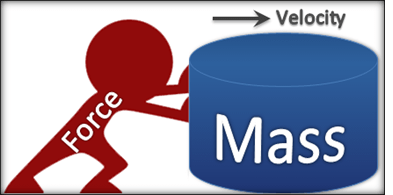


m/s is a unit for
mass
force
acceleration
velocity
Forces come in pairs
Newton's 1st law
Newton's 2nd law
Newton's 3rd law
Law of conservation of momentum
Which law states that the acceleration of an object depends on the force exerted on it and its mass?
1st Law
2nd Law
3rd Law
Henry sees a basketball and decides to put in motion. What kind of force does Henry use to move the ball?
small
balanced
equal
unbalanced
Which activity would BEST demonstrate Newton's law of Inertia?
A plate sits on a table top.
A lady pushes a grocery cart.
A child jumps on a trampoline.
A boy swings a baseball bat.
Which activity would BEST demonstrate the Law of Action/Reaction?
A car traveling down the road.
A rocket launching to space.
A soccer ball sitting on the ground.
A lady pushing a grocery cart.
Which activity would BEST demonstrate the Law of Force and Acceleration?
A lady pushes a grocery cart.
A boy swings a baseball bat.
A soccer ball sits on the ground.
A rocket launches into space.
When there is an INCREASE in MASS of an object you will have a DECREASE in ______________.
friction
acceleration
force
gravity
A jellyfish swims through the water by pulling in water and then pushing the water back out in the opposite direction. This is an example of which law of motion?
1st Law
2nd Law
3rd Law
Billy pushes his little brother on a sled through the snow. He then tries to push his father on the the same sled. He noticed that it was much harder to push his father. Which law is this an example of?
1st Law
2nd Law
3rd Law

Which law is this picture an example of?
Law of Inertia
Law of Action / Reaction
Law of Force and Acceleration

Which law is this picture an example of?
Law of Inertia
Law of Force and Acceleration
Law of Action / Reaction
Ted is playing with a yoyo outside. When he pushes the yoyo downward it returns back to him with the same force. Which law is this an example of?
1st Law
2nd Law
3rd Law


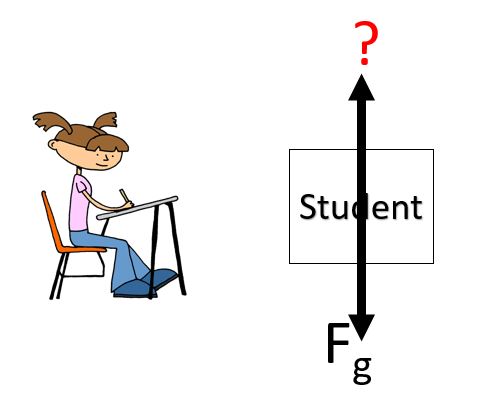
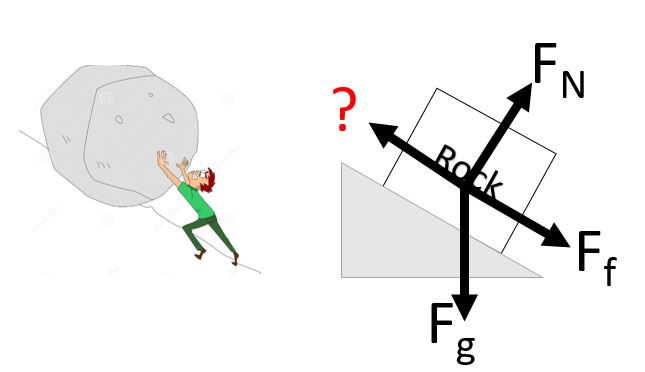
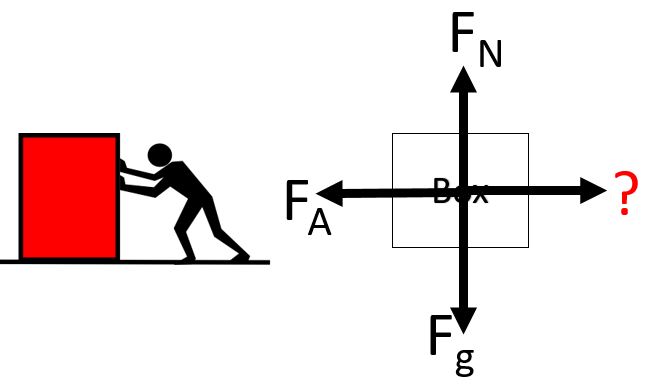
Whenever an object is moving, there is always this force opposing the motion:
inertia
momentum
friction
applied force
The force that keeps objects on top of surfaces instead of letting them sink into the surface is known as:
normal
abnormal
static
inertia
With few exceptions, forces
always come in pairs
are always equal
must be balanced
must be unbalanced
Paired forces are
in opposite directions
always equal
not possible
added together
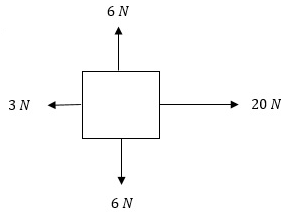
What is the NET FORCE of this diagram?
17 N, right
17 N, left
23 N, right
12 N, up

Which of the following best describes the object in this diagram.
A box sitting on the floor.
A hockey puck gliding to the right.
An athlete running to the right.
A skateboarding gliding to the left.
Which diagram best shows person pushing a couch (accelerating) across the floor?


This diagram can be used to indicate which of the following? (TWO correct answers)
a object at rest
an object moving at a constant velocity (speed)
an object accelerating
(Trick question -- there is only one correct answer)
an object decelerating
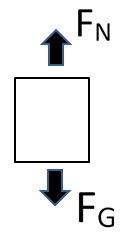
Which of the following is true about this free-body diagram?
the forces are are balanced
the object is free-falling
the object is moving upward
the forces are unbalanced


What is a Free Body Diagram?
Visual representation of force
Visual representation of objects
Visual representation of force and objects interactions
Visual representation of gravity
Force is a __________ quantity.
Vector
Scalar
Vector quantities always have ________ and __________.
Direction and Magnitude
Direction and Value
Value and Units
Angles and Numbers

What can you tell about the forces on F and H?
They must be unbalanced.
They are negative.
They must be the same.
They are equal to the net force.

The Coffee cup in the picture is resting on a table. What force(s) are missing from the free body diagram?
No forces are missing
The normal force from the table pushing the cup up.
The normal force form the table pushing the cup down.
The friction force from the table pushing the cup left and right.

The coffee cup in the picture is at rest on the table. What is true about the Normal force?
The normal force is exactly 15
The normal force is less than 15
The normal force is more than 15
The normal force is -10

A squirrel sits on the ground and eats a donut. If the ground pushes up on the squirrel with a force of 11 N, The squirrel and donut together weigh ...
less than 11 N
Exactly 11 N
More than 11 N

A man pushes a box across the floor at a constant velocity. If another box were put on top of this box, what would happen to the force of friction?
It would increase
It would decrease
It would remain unchanged
Complete the law:
For every action, there is an ____________ reaction.
equal and opposite
equal
opposite
bigger and better
Complete the statement:
When an object is pushed, it __________________ with an equal and opposite force.
always pushes back
pushes back if it has a larger mass
pushes back it if has a smaller mass
will not push back
Every time your cat’s paw hits her toy string, it swings away from her. How does this demonstrate Newton’s third law of motion?
Objects with mass, such as your cat's paw and toy string, will require inertia
Objects in action, such as the string toy, will experience force.
For every motion from your cat's paw, there is unbalanced inertia form the string
For every action your cat makes, there is an equal and opposite reaction from the string.
What happens when two objects, such as a baseball and a bat, collide?
One remains still while the other one moves in the same direction.
They will hit each other with the same force in opposite directions.
They hit each other with unequal force in opposite directions
They hit each other with the same force in the same direction.
What does an object do when it accelerates?
It speed up
It moves in the opposite direction
It changes speed and direction
All the answers are correct
When two objects with unequal mass collide, what will they do?
accelerate at different rates
accelerate in the same direction
come to a complete stop
continue at the same velocity
A softball and a volleyball collide with equal speed, and then they accelerate at the same rate. What must be true about the masses of the objects?
The softball has more mass than the volleyball
The softball and the volleyball have equal mass
The volleyball has more mass than the softball
It is impossible to compare the mass of the softball and the volleyball
During P.E., your soccer ball collides with the goalie. What happens to the soccer ball?
It stops moving completely
It accelerates at the same rate and in the same direction as the goalie.
It accelerates more and in a different direction than the goalie.
It continues moving at the same velocity as before


