
 Worksheets
Unit One
Total questions: 40
Worksheet time: 52mins
Name
Class
Date
1.
A series of steps used by scientists to solve a problem or answer a question.
a)
scientific method
b)
recipe
c)
data collection
d)
metric system
2.
Which is NOT a step in the scientific method?
a)
Make observation
b)
Form a theory
c)
Collect data
d)
Form a hypothesis
3.
A testable explanation to a problem that has not yet been tested.
a)
data
b)
theory
c)
hypothesis
d)
fact
4.
This variable in an experiment is the one being changed by the scientist.
a)
dependent variable
b)
independent variable
c)
data
d)
control group
5.
Testing a hypothesis often involves a(n):
a)
answer
b)
experiment
c)
problem
d)
safety check
6.
What is a hypothesis?
a)
A hypothesis is the right answer to an experiment.
b)
A hypothesis is the wrong answer to an experiment.
c)
A hypothesis is an educated guess.
d)
I don't know.
7.
The summary at the end of an experiment that explains the results.
a)
conclusion
b)
procedures
c)
materials
d)
responding variable
8.
The name of the information that you get from your experiment (you organize it into charts and graphs).
a)
observations
conclusion
conclusion
b)
data
c)
variables
d)
hypothesis
9.
An experiment is performed on plants to see how different liquids affect plant growth. Each plant in the experiment is given a different liquid; water, apple juice, or milk. Each plant has the same amount of soil, sunlight, and listens to the same music. In this investigation, the independent variable is ...
a)
The type of plant
b)
The amount of sunlight
c)
The type of music
d)
The type of liquid
10.
Dependent variable means
a)
the scientist controls what to test
b)
educated guess
c)
ask a question
d)
what is being measured
11.
If you increase the amount of spinach you eat, then you will increase the iron in your blood.
What's the dependent variable?
What's the dependent variable?
a)
increase the amount of iron in your blood
b)
spinach you eat
12.
What is the first step in the scientific method?
a)
Ask a question
b)
Conclusion
c)
No Horse Play
d)
Observe
13.
If I ride my bike to school instead of walking, then I will get to school faster. What is the dependent variable?
a)
True
b)
How fast you get to school
c)
Riding a bike or walking
d)
False
14.
Will a construction paper air plane fly faster than an airplane made from notebook paper? Choose the best hypothesis.
a)
If I make a paper airplane from notebook paper, then it will fly faster than construction paper.
b)
Yes.
c)
No.
d)
I think the construction paper air plane will fly faster.
15.
Which side of a penny will hold more drops of water? Choose the best hypothesis.
a)
If I use the heads side of a penny, then it will hold more drops of water than tails.
b)
Heads
c)
Tails
d)
Tails will hold more drops of water.
16.
If I study for my scientific method test, then I will have a better test score. What is the dependent variable?
a)
Scientific Method
b)
Studying
c)
Independent variable
d)
Test score
17.
If I listen to Mr. Castro's instructions, then I will have less accidents in the lab. What is the independent variable?
a)
Yes
b)
Maybe
c)
Listening or not listening to instructions
d)
Likelihood of having an accident in lab
18.
If I read this question carefully, then I will answer it correctly. What is the independent variable?
a)
I hope so
b)
Yes
c)
Reading or not reading carefully
d)
Likelihood of a correct answer
19.
What are the first two steps of the scientific method in order?
a)
1, 2
b)
Observation, Ask a question
c)
Ask a question, For a hypothesis
d)
Make a plan, Experiment
20.
This part of the experiment serves as a basis of comparison; the one variable being tested has been omitted.
a)
experimental group
b)
control group
c)
data
d)
variables
21.
On what axis should the independent variable always be?
a)
X
b)
Y
22.

Squidward found new reeds to tryout for his clarinet. He used an APPLAUSOMETER to measure applause after playing Under the Sea with each reed. The results were put in the table.
What was controlled?
What was controlled?
a)
The Song
b)
The Reed
c)
The Applause
23.

Squidward found new reeds to tryout for his clarinet. He used an APPLAUSOMETER to measure applause after playing Under the Sea with each reed. The results were put in the table.
What was the independent variable?
What was the independent variable?
a)
The Song
b)
The Reed
c)
The Applause
24.

Squidward found new reeds to tryout for his clarinet. He used an APPLAUSOMETER to measure applause after playing Under the Sea with each reed. The results were put in the table.
What was the dependent variable?
What was the dependent variable?
a)
The Song
b)
The Reed
c)
The Applause
25.

The data collected supports which of the following questions that Squidward could have tested?
a)
Which song does the audience prefer?
b)
Which instrument does the audience like best?
c)
Which reed length creates the best sound?
d)
How do applause affect performance?
26.
You know that 12 inches = 1 foot. Convert 60 inches to feet.
a)
720 feet
b)
5 feet
c)
5 inches
d)
72 feet
27.
You know 1000 mg = 1 g. Convert 2.5 grams into milligrams.
a)
25 mg
b)
25,000 mg
c)
250 mg
d)
2500 mg
28.
Convert 3.5 gallons into cups. (1gal = 16cups)
a)
56 cups
b)
0.21875 cups
c)
19.5 cups
d)
48 cups
29.
How many gallons are in a pool that holds 758,000 Liters?
(1 gallon = 3.79 Liters)
(1 gallon = 3.79 Liters)
a)
200
b)
20,000
c)
200,000
d)
2,000,000
30.
What tool is used to measure liquid volume?
a)
meter stick
b)
triple beam balance
c)
LxWxH
d)
Graduated Cylinder
31.
What is the base unit for measuring mass?
a)
Meter
b)
Liter
c)
Gram
32.
Convert 27.5 cm to meters
a)
275 mm
b)
275 m
c)
.0275 m
d)
.0275 mm
33.
A meter is equal to how many centimeters?
a)
1000
b)
100
c)
10
d)
1
34.
Convert 3.75 kg to grams.
a)
3750 g
b)
375 g
c)
37.5 g
d)
3.750 g
35.
To measure the distance between two towns, what metric unit of length would you use?
a)
kilometers
b)
meters
c)
millimeters
d)
centimeters
36.
To measure the length of a ship, what metric unit would you use?
a)
millimeters
b)
centimeters
c)
meters
d)
kilometers
37.
The base unit of metric length.
a)
Meter
b)
Liter
c)
Gram
38.
The base unit of metric mass.
a)
Meter
b)
Liter
c)
Gram
39.
1000 grams = _____ kilograms
a)
0.0001
b)
1,000,000
c)
10
d)
1
40.
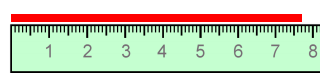
What is the length in centimeters (cm)?
a)
7.2 cm
b)
8.0 cm
c)
7.4 cm
d)
7.7 cm
100 %

