
 Worksheets
Unit 1 - Study Guide
Total questions: 62
Worksheet time: 45mins

Which vocabulary word means to do one particular job?
master craftsman
surplus
specialize
domesticate

Pick all the pictures that show bartering.


Which vocabulary word means something extra, beyond what is needed?
surplus
slurpee
super
subcontinent

What is true about hunter gatherer roles?
Men hunted both gathered
Both hunted and women gathered
Both hunted and gathered
Men hunted and women gathered

Which vocabulary word means any tool or invention used to complete a task?
artifact
computer
vehicle
technology
What is the best example of how an advance in the use of technology made life less difficult for Paleolithic people?
They hunted and gathered.
They discovered how to use fire.
They lived near water sources.
They used caves as shelters.
What do historians call the general early period of human history?
Ancient Age
Bronze Age
Iron Age
Stone Age
How did Paleolithic people arrive in North America?
by boat from Asia
by boat from Europe
by land bridge from Asia
by land bridge from Europe
Long period of extreme cold
nomad
technology
Ice Age
artifact
relating to the earliest period of the Stone Age
Neolithic
Ice Age
artifact
Paleolithic
_____________ is another word for trading.
Service
Bartering
Charities
Good
In the Paleolithic Age
people traveled from place to place hunting animals
gathered fruits, berries and nuts.
lived in caves
All of the above

What is the yellow continent?
Asia
Australia
Africa

What is the orange continent?
South America
North America
Asia

What is the white continent?
Asia
Antarctica
Europe

What is the red continent?
Australia
Europe
South America

What is the tan continent?
Africa
Asia
Europe

What is the brown continent?
Europe
Asia
Africa

What is the largest continent?
Australia
Asia
Africa

What is the coldest continent?
Antarctica
North America
Australia
BCE and ______ represent the same era of time on a timeline.
BC
CE
AD
DC
AD and _____ represent the same era of time on a timeline.
BC
DC
BCE
CE
The most modern terms are ____ and ____ because they exclude religious meaning.
BCE, AD
BCE, CE
BC, AD
CE, BC
This latin term is used to estimate a year if the exact year is unknown.
circa
decade
century
era
How long is a decade?
1 year
10 years
100 years
1000 years
How long is a century?
1 year
10 years
100 years
1000 years
The time before written history is called:
prehistory
circa
timeline
chronological
AD means (2 answers)
In the year of the Lord
Anno domini
After Death
After Christ

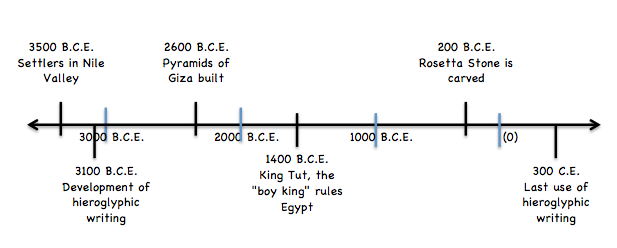
How many years passed between the development of hieroglyphic writing and the carving of the Rosetta Stone?
3,300 years
3,200 years
2800 years
2,900 years
Which year happened first?
567 B.C.
525 A.D.
Which years are included in the 1st Millennium B.C.E.?
1 B.C.E.-1000 B.C.E
15 B.C.E-150 B.C.E
1992-2092 C.E.
None of the Above
Which years would be included in the 1st Millennium C.E.?
2000-2999 C.E.
2001-2010 C.E.
1-1000 C.E.
None of the Above
Which is the same as the 20th century?
1800s
1900s
2000s
2100s
1492 C.E. could also be called
1492 B.C.E.
1492 A.D.
1492 B.C.
What is another name for 1600 C.E.?
1800 C.E.
600 B.C.
1600 B.C.E
1600 A.D.
the taming of wild animals for people's use
agriculture
civilization
specialization of labor
domestication
What change began the Neolithic Age?
hunting
farming
trading
building
What was the greatest benefit to people when early farmers began to raise plants and animals?
easy travel
shared most work
kept pets
stable food supply
What is another name for the Neolithic Age?
Stone Age
New Stone Age
Old Stone Age
The Ice Age
Where did the first civilizations rise?
near rivers
near mountains
North America
Near a sea
Which Characteristic of a Civilization has law codes, religion & economy that's organized
Complex Institutions
Advanced Cities
Specialized Workers
Record Keeping & Writing
Advanced Technology
Which Characteristic of a Civilization is this? were centers of political, economic, & religious life - more than collections of people
Complex Institutions
Advanced Cities
Specialized Workers
Record Keeping & Writing
Which Characteristic of a Civilization is this? result of food surplus, had workers such as artisans, traders, & soldiers
Advanced Technology
Record Keeping & Writing
Specialized Workers
Advanced Cities
Which Characteristic of a Civilization is this?recorded laws, wrote down rituals, recorded trade, writing system to record thoughts & ideas
Record Keeping & Writing
Specialized Workers
Complex Institutions
Advanced Technology
Which Characteristic of a Civilization is this?developed new ways with new materials to work with; made work easier, faster & more efficient
Advanced Cities
Advanced Technology
Specialized Workers
Record Keeping
Which are Characteristics of a Civilization?
Advanced Technology
Specialized Workers
Record Keeping & Writing
Complex Institutions
Advanced Cities

