wayground logo

Free Printable Worksheets

Font size

S
M
L
XL
Worksheets

Ecology Terms Quiz

Total questions: 25

Worksheet time: 3600secs

Name
Class
Date
1.

Fish?

a)

Biotic (living)

b)

Abiotic (non-living)

2.

Air?

a)

Biotic (living)

b)

Abiotic (non-living)

3.
A tapeworm lives in the intestines of a dog. It absorbs food the dog has eaten and grows larger in the process. The dog becomes weaker from malnutrition. What type of symbiotic relationship is this?
a)
mutualism
b)
commensalism
c)
parasitism
d)
predation
4.
The flower of the yucca plant provides the only location where the yucca moth can lay her eggs. In the process, the moth pollinates the yucca flower. What type of symbiotic relationship is this?
a)
mutualism
b)
commensalism
c)
parasitism
d)
predation
5.
Nematodes (a round worm) live in plants and gain nourisment from the plant but do not seem to harm it. What type of symbiotic relationship is this?
a)
mutualism
b)
commensalism
c)
parasitism
d)
predation
6.
A relationship between two organisms in which one organism benefits and the other is harmed.
a)
Mutualism 
b)
Competition
c)
Parasitsm 
d)
Commensalism 
7.

What are the living and nonliving things in an environment or area?

a)

predator

b)

producer

c)

ecosystem

d)

abiotic factor

8.

Members of a species in a defined area

a)

ecosystem

b)

community

c)

biome

d)

population

9.
All the organisms in a particular location, including their nonliving environment
a)
ecosystem
b)
carnivore
c)
niche
d)
population
10.
Study of interactions between organisms and their environment 
a)
niche
b)
community 
c)
ecology
d)
ecosystem
11.

What is the difference between the biotic and abiotic factors?

a)

Biotic factors are living things and abiotic factors are nonliving things.

b)

Biotic factors are nonliving things and abiotic factors are living things.

12.

What is a example of an abiotic factor?

a)

Panda

b)

Bacteria

c)

Butterfly

d)

Weather

13.
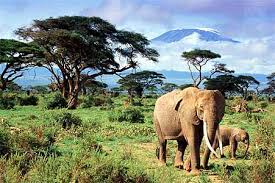
What are the biotic factors in this image?
a)
sunlight, elephants, and grasses
b)
sunlight, water,  and air
c)
elephants, plants, trees 
14.
An organism's _________ is defined as the environment in which it lives.
a)
habitat
b)
niche
c)
social structure
d)
ecosystem
15.
all the snakes in the area 
a)
organism 
b)
ecosystem 
c)
population 
16.
What are groups of different populations living togther in the same place at the same time called?
a)
An organism
b)
A population
c)
A community
d)
A biosphere
17.
Organisms that look similar and can produce fertile offspring
a)
Species
b)
Fish
c)
Community
d)
Trees
18.
In predation, the organism that kills another organism for food is the prey.
a)
True
b)
False
19.
The study of how living things interact with one another and with their environment.
a)
Biology
b)
Lithology
c)
Ecology
d)
Farmacology
20.
This picture is a great example of ____________ biodiversity.
a)
high
b)
moderate
c)
low
d)
hhhmmmm there is no way to know without counting.
21.
This picture is a great example of ____________ biodiversity.
a)
high
b)
moderate
c)
low
d)
hhhmmmm there is no way to know without counting.
22.
What does biodiversity mean?
a)
Only one species in an area.
b)
The different amount of species in an area
c)
All abiotic life
d)
Nitrogen fixation
23.
What is a group of honey bees living together called?
a)
Honeycomb
b)
Hive
c)
Colony
d)
Brood
24.

Resources that we find in nature and are used without much modification are called:

a)

Human resources

b)

Natural resources

c)

Renewable resources

d)

Human made resources

25.

Anything that can be used to satisfy human needs is a:

a)

Thing

b)

value

c)

Resource

d)

Utility