
 Worksheets
States of Matter
Total questions: 18
Worksheet time: 11mins
Name
Class
Date
1.
What happens when my glass of water is sitting in the sun and disappears into a gas?
a)
evaporation
b)
burning
c)
melting
d)
freezing
2.
Which form of matter does not take the shape of its container?
a)
liquid
b)
gas
c)
solid
d)
air
3.
How is a gas defined?
a)
Indefinite shape, indefinite volume
b)
Definite shape, definite volume
c)
Found in stars
d)
Definite volume, indefinite shape
4.
What term describes a solid changing to a gas?
a)
Deposition
b)
Sublimation
c)
Evaporation
d)
Freezing
5.
What term describes a liquid changing to a solid?
a)
Deposition
b)
Sublimation
c)
Evaporation
d)
Freezing
6.
Particles of a liquid
a)
are tightly packed together and stay in a fixed position.
b)
have no viscosity.
c)
decrease in volume with increasing temperature.
d)
are free to move around one another but still touch.
7.
Particles (molecules) in a ______________________ have more energy than the other states of matter.
a)
gas
b)
solid
c)
liquid
8.
______________________ takes place when a liquid changes to a solid.
a)
freezing
b)
melting
c)
boiling
d)
sublimation
9.
Molecules are closest together in a
a)
Solid
b)
Liquid
c)
Gas
10.
The state of matter that has no definite size or shape is
a)
Solid
b)
Liquid
c)
Gas
11.
Which state of matter has the lowest compressibility?
a)
Solid
b)
Liquid
c)
Gas
d)
Plasma
12.
When a gas changes directly to a solid, the process is known as what?
a)
Sublimation
b)
Condensation
c)
Deposition
d)
Evaporation
13.
Define a liquid.
a)
Indefinite shape, indefinite volume
b)
Definite shape, definite volume
c)
Found in stars
d)
Definite volume, indefinite shape
14.
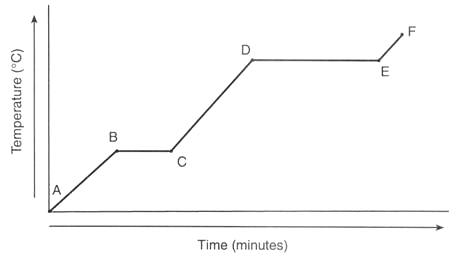
What state/phase is the object likely from points A to B?
a)
Solid
b)
Liquid
c)
Gas
d)
Plasma
15.
What is happening to the particles in the substance between points D and E?
a)
Melting
b)
Freezing
c)
Vaporizing
d)
Sublimating
16.
During a phase change what happens to temperature?
a)
it increases
b)
it decreases
c)
depends; if being heated it increases, if being cooled it decreases
d)
stays constant
17.
7. All phase changes (changing states) requires energy to be added or taken away.
a)
True
b)
False
18.
What happens to particles when they are heated?
a)
They speed up and spread out
b)
They slow down and compress
c)
They stop moving
d)
They move closer together and speed up
100 %

