

wayground logo

Free Printable Worksheets

NEW

Font size

S
M
L
XL
Worksheets

Sponges/Cnidarians

Total questions: 25

Worksheet time: 21mins
Name
Class
Date
1.
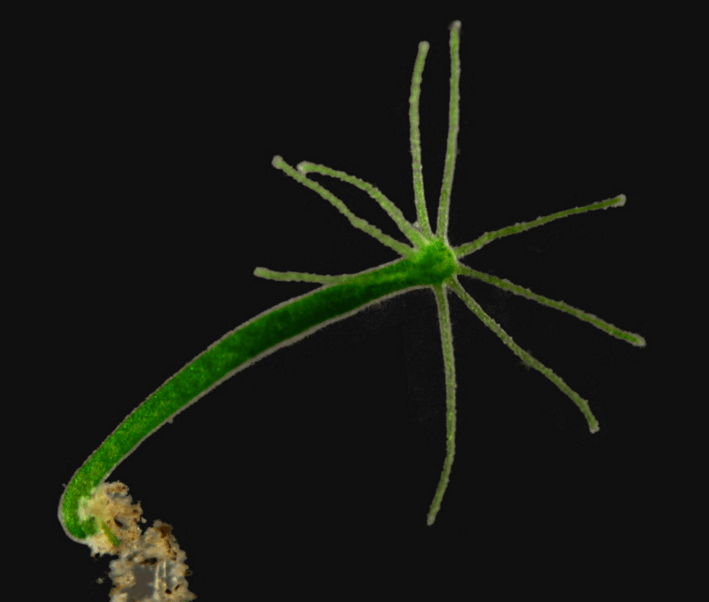
I have a digestive cavity with one opening, and have tentacles.  I am a hydra.
a)
Echinoderm
b)
Cnidarian
c)
Arthropod
d)
Mollusk
2.
Which phylum is mainly asymmetrical?
a)
cnidaria
b)
porifera (sponges)
c)
echinodermata
d)
arthropoda
3.
These organisms all have nematocysts.
a)
cnidaria
b)
mollusca
c)
arthropoda
d)
porifera
4.
What filters food and eliminates waste from the water it lives in?
a)
sponge
b)
segmented worm
c)
arthropod
d)

Cnidarian

5.
Sponges use pores to 
a)
move from place to place.
b)
filter food from the water.
c)
defend themselves.
6.
Cnidarians have what kind of symmetry?
a)
Radial
b)
Bilateral
c)
Asymmetrical
7.
Nematocysts (stinging cells) are used for...
a)
Defense
b)
Catch organisms for food
c)
Both of these
8.
Cnidarians use _______ to sting their prey.
a)
red blood cells
b)
cysts
c)
nematocysts
d)
setae
9.
Sponges are members of the ________ Kingdom.
a)
Animal
b)
Larva
c)
Porifera
d)
Sessile
10.

Which of these is a picture of a choanocyte?

a)
b)
c)
d)
11.

The large opening at the top of the sponge is called the

a)

Osculum

b)

Porocyte

c)

Spicule

d)

Spongocoel

12.
Choanocytes are also known as _____.
a)
epithelial cells
b)
amoeboid cells
c)
collar cells
d)
pore cells
13.

The first organisms to evolve tissues that helped with the movement of the organism?

a)

Sponges

b)

Cnidarians

c)

Poriferians

d)

Algae

14.

This picture of a sea anemone would represent which form of a Cnidarian?

a)

Larval

b)

Polyp

c)

Medusa

d)

Free-swimming

15.

True or False? Both Porifera and Cnidaria can reproduce via asexual and/or sexual reproduction.

a)

True

b)

False

16.

Which phylum first developed a mouth with a central digestive area due to the two cell layers, endoderm and ectoderm.

a)

Porifera

b)

Cnidaria

17.

Cnidarians were the first animals to develop _____________ cells so they could react to their environment.

a)

epidermis

b)

gastrodermis

c)

nerve

d)

collar

18.
Animals whose body parts are arranged in a circle around a center point have
a)
radial symmetry
b)
spherical symmetry
c)
asymmetry
d)
bilateral symmetry
19.

Jellylike material that absorbs and digests the food particles that are caught in the filtering process, move nutrients, and transport oxygen and waste.

a)

Pinacocytes

b)

Choanocytes

c)

Amoebocytes

d)

Spicules

20.

These leathery and thin cells form the sponge's outer layer.

a)

Pinacocytes

b)

Choanocytes

c)

Amoebocytes

d)

Spicules

21.

Also called "collar cells" they have a flagella that helps them pull water into the organism and microvilli that filter the food.

a)

Pinacocytes

b)

Choanocytes

c)

Amoebocytes

d)

Spicules

22.

Sessile

a)

Sponge

b)

Cnidarian

c)

Both

23.

Multicellular

a)

Sponge

b)

Cnidarian

c)

Both

24.

Has a "stomach"

a)

Sponge

b)

Cnidarian

c)

Both

25.

Represent the first transition from unicellular to multicellular animals.

a)

Sponge

b)

Cnidarian

c)

Both
