
 Worksheets
Atomic Structure
Total questions: 30
Worksheet time: 23mins
Name
Class
Date
1.

Complete the missing label on the diagram.
a)
Neutron
b)
Center
c)
Nucleus
d)
Sub atomic particle
2.

How many neutrons does this sodium atom have? (Use the image to help you)
a)
23
b)
11
c)
12
d)
34
3.

How many protons does an aluminium atom have? (Use the image to help you)
a)
27
b)
14
c)
40
d)
13
4.
The total number of protons and neutrons in an atom is called the...
a)
Atomic number
b)
Proton number
c)
Mass number
d)
Weight number
5.
What mass does a neutron have?
a)
1
b)
0
c)
-1
d)
+2
6.
What electrical charge does a proton have?
a)
+1
b)
0
c)
-1
d)
+2
7.
Which subatomic particles are found in the nucleus of an atom?
a)
Protons and Electrons
b)
Protons and Neutrons
c)
Neutrons and Electrons
d)
Protons, Neutrons and Electrons
8.
What is atomic number?
a)
Number of protons in an atoms
b)
Number of neutrons in an atom
c)
Mass of an atom
d)
Charge on an atom
9.
Atoms of the same element must always have the same number of _________
a)
electrons
b)
neutrons
c)
isotopes
d)
protons
10.
The _________ of an element equals the number of protons in an atom of that element
a)
mass number
b)
atomic weight
c)
atomic number
d)
isotopes
11.
The __________ of an atom is the sum of the protons and neutrons in the nucleus of that atom.
a)
mass number
b)
atomic number
c)
atomic weuight
d)
isotope weight
12.
The mass number of an element that has18 protons, 18 electrons, and 19 neutrons is _____.
a)
12.5
b)
13
c)
25
d)
37
13.
The atomic number of an element that has 9 protons, 9 electrons, and 10 neutrons is _____.
a)
9
b)
10
c)
19
d)
28
14.

What element is represented in this Bohr Model?
a)
Carbon
b)
Hydrogen
c)
Aluminum
d)
Lithium
15.
Which particle is negatively charged?
a)
proton
b)
atom
c)
neutron
d)
electron
16.
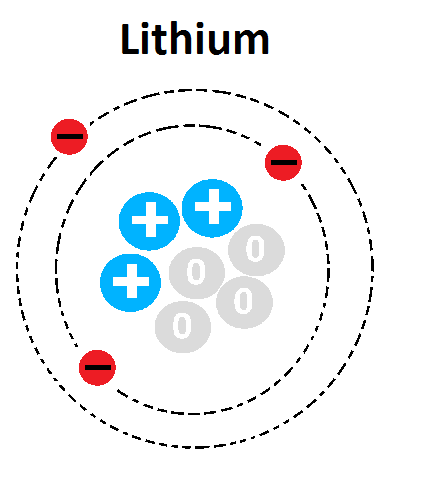
What is the atomic number of this atom?
a)
1
b)
3
c)
4
d)
7
17.
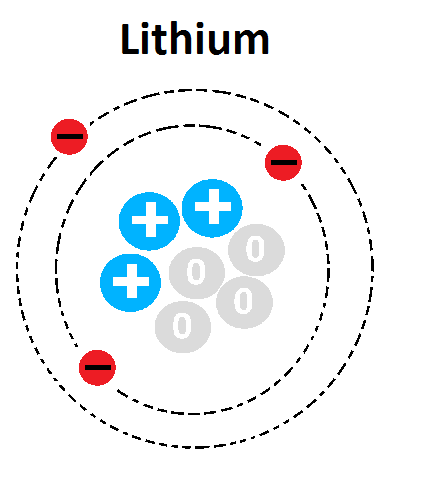
What is the mass number of this atom?
a)
1
b)
3
c)
4
d)
7
18.
Most of the mass in an atom is made up of _____________________?
a)
protons and electrons
b)
protons and neutrons
c)
neutrons and electrons
d)
electrons and quarks
19.
In order for an atom to be neutral what has to be true?
a)
The atom has more protons than neutrons
b)
The atom has more neutrons than protons
c)
The atom has the same number of protons and neutrons
d)
The atom has the same number of protons and electrons
20.
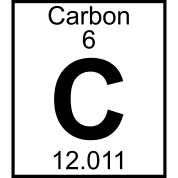
What does the C represent?
a)
atomic mass
b)
atomic number
c)
element name
d)
chemical symbol
21.

What does the 6 represent?
a)
Atomic mass
b)
atomic number
c)
chemical symbol
d)
element name
22.
How is the number of neutrons in the nucleus of an atom calculated?
a)
Add the number of e- and p+ together
b)
Subtract the number of e- from p+
c)
Subtract the number of p+ from the mass number
d)
Add the mass number to the number of e-
23.
If an atom has 12 positively charged subatomic particles, which of the following must it also have to be considered a neutral atom?
a)
12 neutrons
b)
12 electrons
c)
12 protons
d)
24 protons and neutrons
24.
An atom has 10 protons, 15 neutrons and 10 electrons what is its mass number.
a)
20
b)
10
c)
35
d)
25
25.
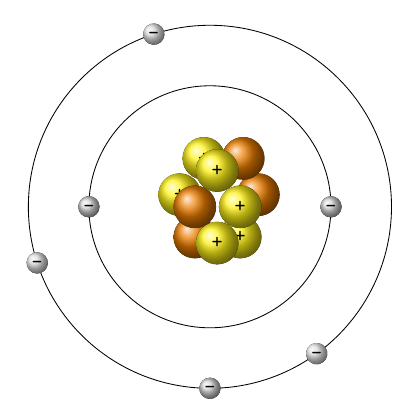
How many electrons does this atom have?
a)
2
b)
4
c)
6
d)
10
26.
An element with a mass number of 11 and an atomic number of 5 has how many neutrons?
a)
11
b)
5
c)
6
d)
16
27.
If an element has 14 protons, 15 neutrons, and 14 electrons, what is that elements atomic mass
a)
28
b)
14
c)
29
28.

What element does the Bohr Model represent?
a)
Nitrogen
b)
Potassium
c)
Sodium
29.

For an atom, the number of electrons is equal to the number of _____
a)
protons
b)
protons plus neutrons
c)
neutrons
d)
nucleons
30.

What is the Element's atomic number?
a)
Fe
b)
26
c)
55.847
d)
Iron
100 %

