
 Worksheets
Chapter Test Ring of Disasters Part 1
Total questions: 10
Worksheet time: 8mins
Do earthquakes, active volcanoes and mountain belts occur randomly on Earth?
Yes
No
Where can we find most of the earth's active volcanoes and mountain belts?
anywhere on earth
in between continents
in between plates
at the center of plates
Which of the following statements is NOT true about the inner core?
It is the hottest layer of the earth.
It is in solid form.
It is composed mainly of iron.
It is the largest part of the earth.
The following statements describe the earth's lithosphere EXCEPT:
It is composed of the crust and upper mantle.
It is the rigid part of the earth.
It contains magma.
It is composed of blocks called plates.
Alfred Wegener is a German scientist who hypothesized that the earth was once made up of a single large landmass called Pangaea. Which of the following theories did he propose?
Continental Shift Theory
Plate Tectonics Theory
Continental Drift Theory
Seafloor Spreading Theory
According to Plate Tectonics Theory, how many plates make up the lithosphere?
7
8
15
13
Which of the following is the reason why Wegener's proposal was initially rejected?
He was a geologist.
He could not present any evidence to support his proposal.
He could not explain the mechanism of continental drift.
According to Harry Hess, continents move because of __________.
pull of gravity
rotation of the earth
ocean floor movement
wind
Which of the following theories categorized the tectonic plates as continental and oceanic?
Continental Drift Theory
Seafloor Spreading Theory
Plate Tectonics Theory
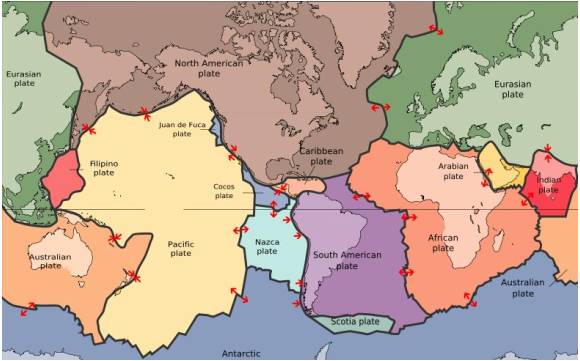
The map in the picture shows tectonic plate boundaries. This map would be useful in predicting the location of future
droughts
hurricanes
earthquakes
tornadoes

