
 Worksheets
yr 7 fossils
Total questions: 24
Worksheet time: 13mins
Name
Class
Date
1.

The diagram shows layers of sedimentary rock and examples of the fossils each layer contains, Which layer contains the oldest fossils?
a)
A. Layer 2
b)
B. Layer 4
c)
C. Layer 1
d)
D. Layer 3
2.
Where are most fossils found?
a)
A. In sand dunes
b)
B. In volcanoes
c)
C. In igneous rocks
d)
D. In sedimentary rocks
3.

Which fossil layer is the youngest?
a)
A. Layer A
b)
B. Layer B
c)
C. Layer C
d)
D. Layer D
4.
How are Sedimentary Rocks formed?
a)
A. Cooling and Hardening
b)
B. Melting and heating
c)
C. Compacting and Cementing
d)
D. Time
5.
How are fossils created?
a)
A. Traces of organisms harden like rock.
b)
B. Dead organisms are quickly buried for millions of years.
c)
C. Animals get trapped.
d)
D. All of the above
6.
An organism that no longer exists on Earth is called
a)
Decayed
b)
Evolved
c)
Extinct
d)
Preserved
7.

What type of fossil is this?
a)
Mold
b)
Cast
c)
Preserved remains
d)
Trace fossil
8.

What type of fossil is this?
a)
Trace fossil
b)
Mold
c)
Cast
d)
Carbon film
9.

What type of fossil is this?
a)
Mold
b)
Cast
c)
Preserved remains
d)
Petrified
10.

Which of the following is NOT an example of a fossil?
a)
a petrified dinosaur bone
b)
a footprint captured in mud
c)
a seashell found on the beach
d)
an insect stuck in amber
11.
Which of the following is NOT something you could learn from a fossil?
a)
The size of the animal
b)
What the animal ate
c)
The color of the animal
d)
Where the animal lived
12.
In order for a fossil to form, which of the following events must happen FIRST?
a)
Slowly, minerals in the water replace the bone.
b)
Sediment covers the bone.
c)
An animal dies.
d)
The bone is no longer a bone, but a rock copy.
13.

Why don't we know what many ancient plants looked like?
a)
They had too many soft parts.
b)
They were all eaten by dinosaurs.
c)
There weren't ancient plants.
d)
They had too many hard parts.
14.
Where can the oldest layer be found?
a)
The top layer
b)
The middle layer
c)
They are all the same age
d)
The bottom layer
15.
The Law of Superposition helps scientists to determine what?
a)
The absolute age of rock layers
b)
The age of fossils
c)
The relative age of rock layers
d)
the super powers of rocks
16.

Look at the diagram, what layer did animal E first show up in?
a)
Layers #4
b)
Layers #5
c)
Layers #6
d)
Layers #7
17.
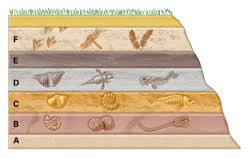
Which rock layer contains the newest fossils?
a)
F
b)
E
c)
B
d)
C
18.
What is hardened tree sap called?
a)
coprolites
b)
index fossils
c)
gastroliths
d)
amber
19.

Which layer formed first?
a)
Rock Layer W
b)
Rock Layer X
c)
Rock Layer Y
d)
Rock Layer Z
20.
Which is a mold?
a)
the impression left by an organism
b)
a copy of the organism, like a statue
21.
Which is a cast?
a)
the impression in a rock left by the organism
b)
a copy of the organisms made of sediment
22.
Coal is the carbon left over from plants in between rock layers. Is coal technically a fossil?
a)
yes
b)
no
23.
Who studies ancient environments?
a)
biologists
b)
specialologists
c)
paleontologists
d)
scientologists
24.
A scientist finds footprints in a fossilized stream bed. This is a ________.
a)
carbon film
b)
mineral replacement
c)
cast fossil
d)
trace fossil
100 %

