
 Worksheets
5.5ab Parts of a Cell, Vascular and Nonvascular Plants
Total questions: 20
Worksheet time: 21mins
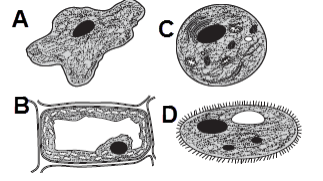
Which plants shown are Nonvascular? (Click on each you want to select. You must select all the correct answers.)


Which part of the cell gives direction to the entire cell?
Cell Membrane
Cytoplasm
Nucleus
Vacuole

What part of the cell stores water, nutrients, and waste?
Cell Wall
Cytoplasm
Nucleus
Vacuole

What is the thick, rigid structure that surrounds and protects the plant cell and gives the cell its shape?
Cell Wall
Vacuole
Cytoplasm
Chloroplast

This tool that can be used to see the inside parts of a cell:
Magnifying Glass
Balance Scale
Microscope
Graduated Cylinder

What part of the plant cell uses energy from sunlight to make food and gives the cell its green color?
Cytoplasm
Chloroplasts
Cell Wall
Vacuole

Which is an example of an Animal Cell? (A or B)
A
B

Two parts that are found in a plant cell, but not in an animal cell are...
Cell Wall
Vacuole
Nucleus
Cell Membrane
Chloroplast

If you put 2 white flowers into separate cups of water, 1 with red food coloring & 1 with clear water, what will you see when you check on them the next day?
Flower in red water has turned red; No change in other flower.
Both flowers have turned red
Flower in clear water has turned red; No change in other flower.
No change in either flower

Which of these are TRUE about vascular plants?
They only grow close to the ground
They transport water with xylem & phloem
They include mosses
They don't have roots & stems

What do the vascular tissues in a plant do?
Attract pollinators
Capture sunlight to make food
Transport food & water
Open to let extra water out
Which type of plant gets water directly from their environment?
Vascular Plants
Nonvascular Plants
All living things are made of:
cytoplasm
cells
vascular tissue
vacuoles

