
 Worksheets
Review for Midterm III.1 Gases
Total questions: 30
Worksheet time: 18mins

A gas is composed of tiny particles separated by _________________ ___________.
air and water
empty space
gas bubbles

True or False: According to the kinetic theory all collisions of gas particles are elastic.
True
False

Temperature is a measure of
Average kinetic energy
Amount of Heat
Amount of Coldness
Average Warmth

Absolute zero is defined as (select two)
the coldest possible temperature
the temperature where there is no motion
a really cold temperature
100 degree Kelvin

1 atm is equal to:
780 mmHg.
760 atm
101,3 KPa.
all of the above

When thermal energy is added to a substance, the substance's particles move:
More rapidly and increase the distance between each other.
More rapidly with less distance between each other.
More slowly with a greater distance between each other.
More slowly with a reduced distance between each other.


If an object has particles that are moving very slowly, the object's temperature is probably ______.
hot
small
cold
big

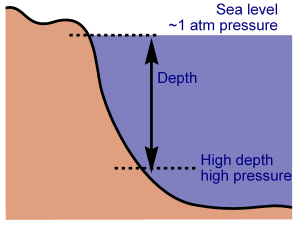
When you increase your depth under water, the water pressure on your body
increases
decreases
stays the same

What decreases as you go up in the atmosphere?
Altitude
Atmosphere
Meteors
Atmospheric Pressure

What is the unit of measurement for pressure?
pascal
grams
milliters
meters

An object will float on water if it is
less dense than water.
more dense than water.
the same density as water.

This is an example of the everyday application of pressure in:
Solids
Liquids
Gases
Plasma

The pressure inside the syringe will decrease if we move the plunger in:
Direction A
Direction B
We don't have to move the plunger as the pressure will change on its own.
None of the above answers.

Weather balloons travel to a great height gathering data before the balloon bursts. This is because the atmospheric pressure (layer of gas surrounding the earth):
Increases the higher you travel.
Decreases the higher you travel.
Remains the same.
Not enough information to answer the question.

The reason gases can be compressed is because:
The particles are very close together.
The particles are merely vibrating.
The particles are unable to move.
The particles are very far apart.
A gas is at a pressure of 95 kPa. What is its pressure in atmospheres?
1.5 atm
1.09 atm
0.94 atm
0.82 atm

The gas in my car's tires is at 2 atm. How many Kilopascals is this?
4.26 Pa
2.8 Pa
202.6 Pa
202.6 Kpa

What does STP (standard temperature and pressure) stand for?
0ºC and 1 atm
1.0 mmHg and 273 K
1.0 ºC and 0 atm
1.0 atm 273 ºC
How many mm Hg is a pressure of 1.05 atm?
529 mm Hg
798 mm Hg
104.8 mm Hg
760 mm Hg

Fluids include__ and__.
solids and liquids
solids and gases
liquids and gases
liquids


The pressure in a gas tank can reach 500 KPa, convert that to atm.
4.9 atm
4.8 atm
5 atm
4.9 mmHg

The air pressure inside a nuclear submarine is 700 mmHg. What would be that in Kpa?
93.3 Kpa
933 Kpa
9.3 Kpa
93.3 mmHg

True or False: Gases fill any container.
True
False

Where would you find less oxygen?
Denver (1609 m altitude)
Atacama Chile (1 m altitude)
El Alto, Bolivia (4150 m altitude)
Barranquilla (18 m altitude)
Convert 5623 mmHg to Kpa
749.7 Kpa
854 Kpa
794.7 Kpa
1212 Kpa

All these tanks contain same # of molecules of gas and same temperature. Which one has a bigger pressure?
The biggest one
All of them, the same.
The smallest one.

