Wayground logo

Free Printable Worksheets

Font size

S
M
L
XL
Worksheets

Space Science Review 1

Total questions: 26

Worksheet time: 11mins

Name
Class
Date
1.
Which of the following is evidence of the Big Bang Theory?
a)
Cavemen heard a loud bang at the beginning of time.
b)
The universe isn't moving
c)
The universe is expanding
d)
The universe is getting smaller
2.
Which of the following is NOT evidence of the Big Bang Theory?
a)
Abundance of Hydrogen and Helium
b)
CMBR everywhere
c)
Stars that are blue shifted
d)
the universe is getting bigger
3.

Why does a planet move faster when close to the Sun?

a)

It's excited

b)

gravity from Sun pushes harder so it goes faster

c)

solar energy speeds it up

d)

gravity of Sun pulls harder so it goes faster

4.
Which of the following is NOT true about the Big Bang Theory?
a)
It is the scientific explanation of how life began on Earth and evolved over time.
b)
It is the scientific explanation for the origin of the universe.
c)
It states that the universe expanded from a single point and is still expanding today.
d)
It states that the universe used to be much hotter and smaller.
5.
What can we conclude from the observation that nearly all galaxies are moving away from us?
a)
Massive black holes are drawing galaxies away from Earth.
b)
The Sun and Earth are located at the center of the universe.
c)
Everything in the universe is moving the same direction.
d)
The once-smaller universe is expanding in all directions.
6.
Why do red-shifted light spectrums from neighboring galaxies  indicate the universe is expanding?
a)
Red light has the shortest wavelength on the visible light spectrum
b)
Red light has the longest wavelength on the visible light spectrum
c)
Red light has both long and short wavelengths on the visible light spectrum
d)
Red light has neither long, not short wavelengths on the visible light spectrum
7.

Which statement is true?

a)

The galaxies are moving toward us.

b)

The galaxies are moving away from us.

c)

The universe remains static or unchanged in motion.

d)

None of the above

8.

Light emitted from a star or galaxy can be separated into a band of colors, called a ________.

a)

Red Shift

b)

Wave Length

c)

Spectrum

d)

Microwave

9.
The three pieces of evidence for our current theory of the universe are:
a)
blueshift, CMB, moon landing.
b)
redshift, IBM, Andromeda galaxy.
c)
redshift, CMB, distribution of elements.
d)
doppler effect, light spectra, fusion.
10.
Galaxies that are redshifted are:
a)
actually blue.
b)
really far away.
c)
invisible.
d)
moving away from us.
11.
The CMB is:
a)
the remaining energy from the big bang.
b)
incredibly hot.
c)
visible to the human eye.
d)
only located in certain places in the universe.
12.
CMB stands for:
a)
Colorful Mystic Background Rehearsal.
b)
Cosmic Mini Butterfly Repellent.
c)
Cosmic Microwave Background Radiation.
d)
Cute Microwave Button Reversal.
13.
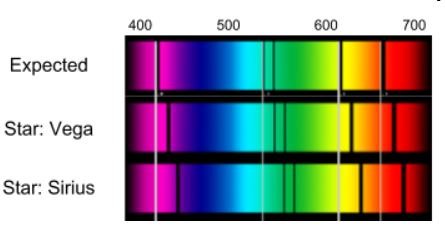
What is true about these stars?
a)
Both of these stars are moving away from us.
b)
Both of these stars are moving towards us.
c)
Both of these stars are blueshifted.
d)
The star Sirius is closer to us.
14.

The time it takes for an orbiting object to make one orbit

a)

orbit

b)

period

c)

mass

d)

weight

15.

The curved path an object takes when orbiting another object

a)

orbit

b)

period

c)

mass

d)

weight

16.

Orbiting objects travel in the shape of ___________

a)

a circle

b)

a parabola

c)

an ellipse

d)

an egg shape

17.

The force of attraction between any two objects is _________.

a)

love

b)

gravity

c)

weight

d)

magnetism

18.

A tool used by scientists to analyze the different wavelengths of light.

a)

spectrometer

b)

thermometer

c)

binoculars

d)

microscope

19.

The difference between a circle and an ellipse is that an ellipse has _________ focal point(s).

a)

one

b)

two

c)

three

d)

four

20.

According to the formula for gravity, if objects get closer together the force of gravity will __________.

a)

decrease

b)

increase

c)

stay the same

d)

go up, then down

21.

Using the gravity formula

 F = (m1 m2)d2F\ =\ \frac{\left(m_{1\ }m_2\right)}{d^2}  explain what would happen to the force if the mass of object one triples and the mass of object two triples.

a)

3 times bigger

b)

6 times bigger

c)

9 times bigger

d)

12 times bigger

22.

Using the gravity formula

 F = (m1 m2)d2F\ =\ \frac{\left(m_{1\ }m_2\right)}{d^2}  explain what would happen to the force if the distance between the two objects doubles.

a)

double the force

b)

quadruple the force

c)

1/2 the force

d)

1/4 the force

23.
The force of gravity acting on an object is the object's ______.
a)
mass
b)
matter
c)
weight 
d)
friction 
24.
The amount of matter in an object is 
a)
pressure
b)
weight
c)
mass
d)
force
25.
A planet moves __________ when it is farthest from the sun.
a)
faster
b)
slower
26.
The farther away a planet is from the sun, the _______ it takes it to orbit the sun once. 
a)
longer
b)
shorter