
 Worksheets
3.1 Classification of elements
Total questions: 15
Worksheet time: 15mins
In the modern periodic table, the period indicates the value of:
Atomic number
Atomic mass
Principal quantum number
Azimuthal quantum number.
The elements which occupy the middle block (d) in the periodic table are called ................ elements.
transition
alkali
alkaline earth
noble
In the periodic table, the elements which are similar in their Chemical & physical properties are located in the same ................
period
group
nucleus
energy level
Choose which of the following position is correct for Neon (z = 10)
Period : 2
Group : 17
p-block
Period : 2
Group : 18
s-block
Period : 2
Group : 18
p-block
Choose the correct position for element Krypton (Z= 36)
Group : 18
Period : 4
p-block
Group 8
Period : 4
p-block
Group: 18
Period 3
p-block
Bromine has the valence electronic configuration of 4s2 3d10 4p5. Choose the correct position of Br element in Periodic Table.
Group: 15
Period : 4
d-block
Group: 17
Period: 4
d-block
Group : 17
Period : 4
p-block
In the modern periodic table the block d is
Noble gases
Transitional elements
Metals
Non-metals
In the modern periodic table, the period indicates the value of:
Atomic number
Atomic mass
Principal quantum number
Azimuthal quantum number.
Surrounding the nucleus is a cloud-like region of moving _________________________.
protons
neutrons
electrons
An atom with the same number of protons and a different number of neutrons from other atoms of the same element is called a/an
isotope
energy level
atomic number
neutron
Negatively charged particles in an atom are known as:
protons
neutrons
electrons
A group of two or more atoms held together by chemical bonds:
atom
element
molecule
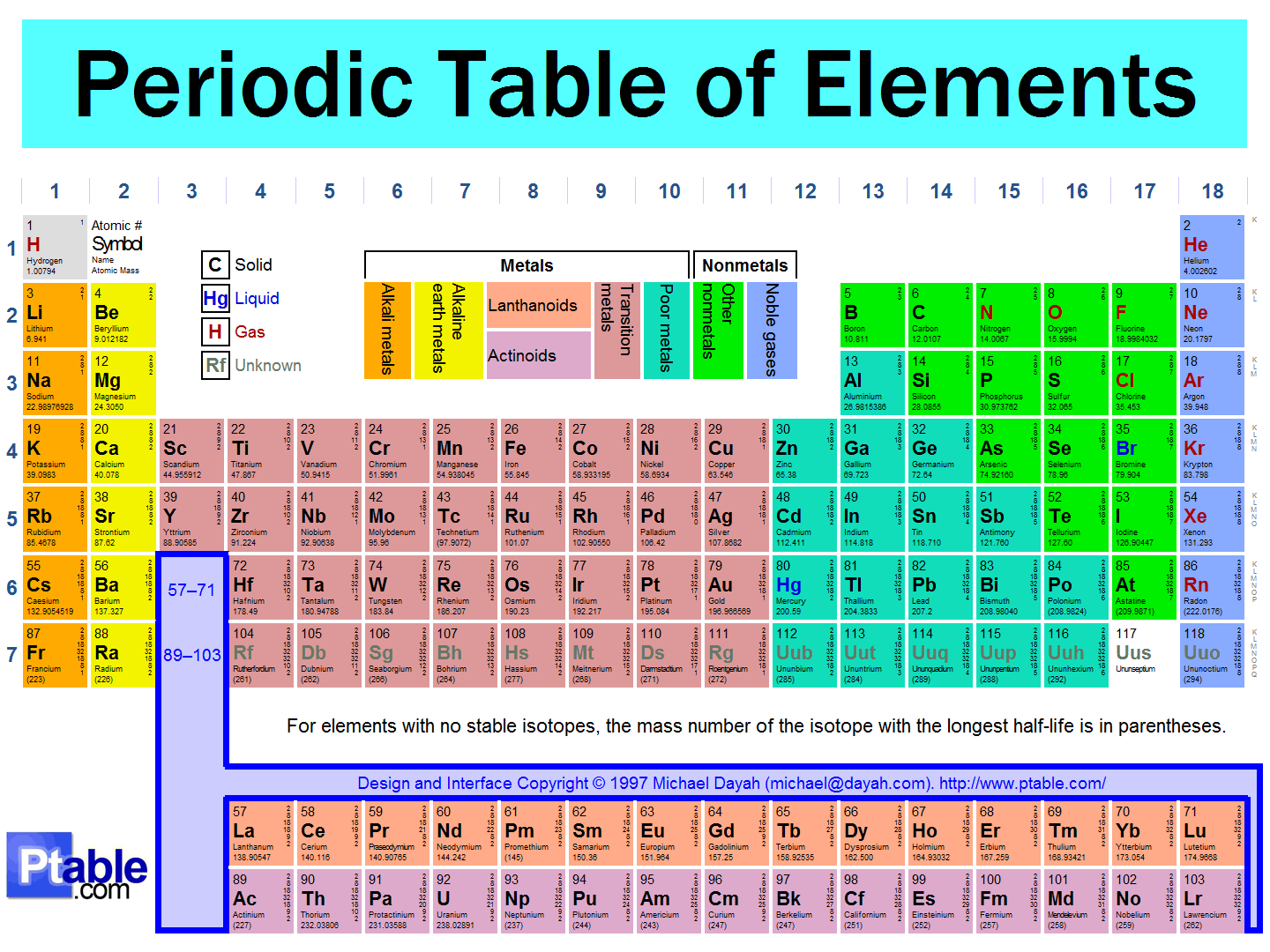
The horizontal (side to side) rows in the Periodic Table are called
groups
families
periods
atomic numbers

