Wayground logo

Free Printable Worksheets

Font size

S
M
L
XL
Worksheets

Density

Total questions: 35

Worksheet time: 33mins

Name
Class
Date
1.
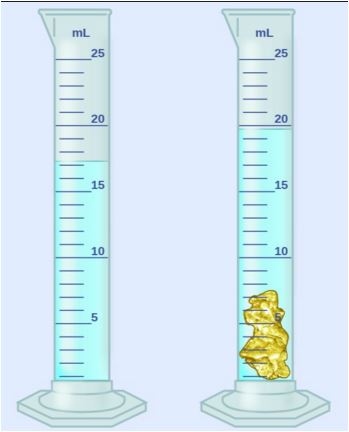
What is the volume of Object X?
a)
10.0 cm3
b)
15.0 cm3
c)
20.0 cm3
d)
25.0 cm3
2.
Jack has a rock. The rock has a mass of 14g and a volume of 2cm3. What is the density of the rock?
a)
7 mL
b)
7 g/cm3
c)
28 g/cm3
d)
1/7 g/cm3
3.
What units can be used to express density?
a)
g/mL
b)
grams
c)
millimeters
d)
milliliters
4.
If an object has a density of .6 g/mL and you put it into water, will it sink or float?  
a)
sink
b)
float
5.
If an object has a density of 3.6 g/mL and you put it into water, will it sink or float?  
a)
sink
b)
float
6.
What units are used to measure mass?
a)
g
b)
cm3
c)
g/cm3
d)
cm3/g
7.
An object should float in a liquid if it is 
a)
Denser than the liquid 
b)
Less dense than the liquid
c)
Lighter than metal
d)
 Shaped like a ball 
8.

What is this tool to get volume?

a)

triple beam balance

b)

ruler

c)

thermometer

d)

graduated cylinder

9.
Why does ice float?
a)
Liquid water is less dense than solid water.
b)
Solid water is less dense than liquid water.
c)
Gaseous water is less dense than solid water.
d)
Liquid water is less dense than gaseous water.
10.
What is the formula for density?
a)
density = mass x volume
b)
density = mass / volume
c)
density = mass + volume
d)
density = mass - volume
11.
Calculate the density of the cube.
a)
2 g/cm3
b)
4 g/cm3
c)
6 g/cm3
d)
8 g/cm3
12.
Which box has a greater density?  
a)
Box A
b)
Box B
13.
Which density will float on water?
a)
0.7 g/cm3
b)
1.2 g/cm3
c)
3.5 g/cm3
d)
11.4 g/cm3
14.
Density is...
a)
the amount of mass in an object
b)
the amount of space an object takes up
c)
the amount of mass in a given space
d)
the weight of an object
15.

This pumice has a mass of 35.4 grams. The same VOLUME of water as this pumice has a mass of 41.2 grams. Will it sink or float?

a)

sink

b)

float

c)

same

16.
Find the volume of this piece of brass.  
a)
50 g
b)
10 cm
c)
6 cm3
d)
12 cm3
17.
The density of this material is 2 g/cm3.
There are 24 cm3  Find the total mass.
a)
12 grams
b)
48 grams
c)
12 g/cm3
d)
48 g/cm3
18.
What is the volume of the fish?
a)
18.0 cm3
b)
6.0 cm3 
c)
38.0 cm3
19.
What is the volume of 150 grams of lead if it has a density of 11.3 g/cm3?
a)
13.3 g
b)
13.3 cm3
c)
.075 g
d)
1695 cm3
20.
A brick sinks in water while a wooden block of the same size floats.  This is because the brick has a
a)
lower volume than the wooden block
b)
lower density than the wooden block
c)
higher volume than the wooden block
d)
higher density than the wooden block
21.
In the water displacement method for finding volume
a)
 You subtract the final volume from the initial volume
b)
You subtract the initial volume from the final volume
c)
You add the initial and final volumes
d)
You divide the final volume by 2 
22.
If you cut a wooden block in half, each half would have 
a)
Half the density of the original piece
b)
 Twice the density of the original piece 
c)
The same density as the original piece
d)
No density at all 
23.

Density is an INTENSIVE property of a substance. This means that the density of water

a)

Changes depending on the volume

b)

Stays the same regardless of the volume

c)

Is greater for a greater mass of water

d)

Is less for a smaller mass of water

24.
An irregularly shaped stone was lowered into a graduated cylinder holding a volume of water equal to 2 ml. The height of the water rose to 7 ml. If the mass of the stone was 25 g, what was its density?
a)
5 ml
b)
16 g
c)
.20 g/ml3
d)
5 g/cm3
25.

A block measuring 2 cm x 2 cm x 5 cm has a mass of 54 grams. What is the density of the block? Density = mass (weight)volumeDensity\ =\ \frac{mass\ \left(weight\right)}{volume}  

a)

1080g/cm3

b)

0.37 g/cm3

c)

34 g/cm3

d)

2.7 g/cm3

26.
An irregularly shaped piece of gold was lowered into a graduated cylinder holding a volume of water equal to 17 ml. The height of the water rose to 20 ml. If the mass of the gold was 27 g, what was its density?
a)
9 g/mL
b)
10.5 g/mL
c)
6.5 g/mL
d)
8 g/mL
27.

Which of the following is NOT a factor that affects density?

a)

Size and shape of the atoms/molecules that make the substance

b)

Size of the sample

c)

Mass of the atoms/molecules that make the substance

d)

Arrangement of atoms/molecules

28.

Density can be used to help identify a material.

a)

True

b)

False

29.

A synonymous term for a characteristic property is an

a)

extensive property

b)

intensive property

30.

If an object sinks in water (1 g/mL), it would also sink in the Dead Sea (1.3-1.4 g/mL)

a)

Yes, water is water

b)

No, everything floats in the Dead Sea

c)

Depends, if the object was less than 1.3 g/mL it would float, if it was more it would still sink

31.
Where do we read the level of liquid?
a)
The highest point the liquid touches
b)
The bottom of the meniscus
c)
Half way between, we make an educated guess and round it
d)
Somewhere about there
32.

Which method should you use to find the volume of this object?

a)

Measure the object with a ruler and use the formula for a cylinder.

b)

Use a graduated cylinder to find the volume by difference

33.
What is the volume of the liquid in this graduated cylinder?
a)
19 mL 
b)
35 mL 
c)
24 mL 
d)
1.9 mL
34.
What is the volume of the liquid in this graduated cylinder?
a)
8.2 mL 
b)
8.02 mL 
c)
82 mL 
d)
9.8 mL
35.

Graphite and Diamond are a great example of

a)

how size, mass, and arrangement of atoms/molecules must all vary to account for differences in density

b)

how even one factor - like arrangement of atoms - may affect the density of an object