
 Worksheets
Evolution
Total questions: 10
Worksheet time: 6mins

Evolution is best defined as:
the process which organisms die.
the process which organisms change over time.
the process which organisms that are extinct become revived.
the process which non-living things fossilize.

The solidified remain or imprint of a once living thing are called:
Fossils
Homologous Structures
Vestigial Structures
DNA

What type of evidence is represented in the picture above:
Fossils
Vestigial Structures
DNA
Homologous Structures

Adaptations are:
physical or behavioral tendencies.
physical or behavioral characteristics that help an organisms survive and reproduce.
physical or behavioral characteristics that do not help the organism in any way.
genetic mutations that have gone wrong.


Which scientist is known for his work that he did on the Galapagos Islands to develop his theory of natural selection?
Gregor Mendel
Charles Darwin
Anton Van Leewenhoek
Robert Brown
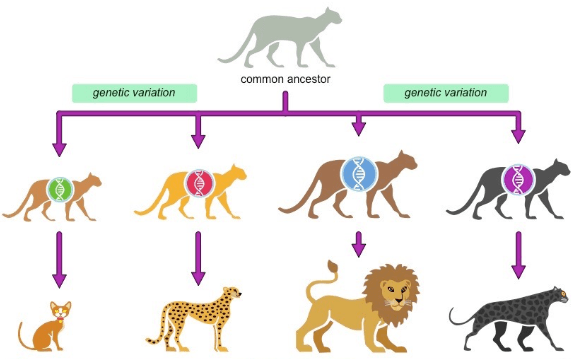
The process by which two populations of the same species become so different that they can no longer interbreed.
natural selection
artificial selection
speciation
fossilization

Overproduction, Genetic Variation, Struggle to Survive, and Successful Reproduction are the 4 parts of:
Natural Selection
Speciation
Artificial Selection
Fossilization

A species is defined as:
a group of organisms that are extremely different.
a group of organisms that have similar characteristics and always live in the same place.
a group of organisms with similar characteristics and can reproduce to make fertile offspring.
any two organisms to make a hybrid.

